American presidential election
It seems like Trump has the upper hand. That's probably why it was broadcast under the banner of having predicted the Trump phenomenon nearly 20 years ago.
Richard Rorty
Richard McKay Rorty (Richard McKay Rorty, 1931 October 4 - 2007June 8) is [United States](https://ja.wikipedia.org/wiki/%E3%82%A2%E3%83%A1%E3%83%AA%E3%82%AB%E5% Philosopher and neopragmatism (Neopragmatism.
University of Chicago, Bachelor's degree, Master's degree, then Yale University in 1956 obtained a PhD. Princeton University's PhilosophyProfessor for 21 years, and University of Virginia After working as professor, Stanford University](https://ja.wikipedia.org/wiki/%E3%82%B9%E3%82%BF%E3%83%B3%E3%83%95%E3%82%A9%E3%83 %BC%E3%83%89%E5%A4%A7%E5%AD%A6) Professor of Philosophy and Comparative Literature. He later became a professor emeritus at Stanford University. Pragmatism, he discussed the "end of philosophy" by reexamining modern philosophy from the standpoint of wikipedia.org/wiki/%E6%94%BF%E6%B2%BB%E5%AD%A6), Economics, Sociology, American culture. He is a philosopher representing modern America. (Wikipedia)
I have never read his work.
Ideology
Wikipedia
Representative of pragmatism John Dewey, Thomas Kuhn, Ludwig Wittgenstein.
Rorty's thoughts as a philosopher are unique History of Philosophy is known for his views. Rorty's work ``Philosophy and the Mirror of Nature' Modern Philosophy. It is René Descartes [Immanuel Kant](https://ja.wikipedia.org/wiki/%E3%82%A4%E3%83%9E%E3%83%8C Epistemology tradition that establishes a solid intellectual foundation on which one can rely to arrive at truth. It was an attempt to And Martin Heidegger and Ludwig Wittgenstein, John Dewey, Michel Foucault, W.V.O. Quine The attack by this epistemology ja.wikipedia.org/wiki/%E8%AA%8D%E8%AD%98%E8%AB%96) I think it was a criticism of the philosophical tradition. And Rorty takes issue with the fact that criticizing the epistemological traditions of modern philosophy does not necessarily mean overcoming them, and argues that philosophy based on such traditions is ``the end of philosophy.''Insist on'. It also suggests the possibility of a philosophical hermeneutics that does not use the epistemological tradition that bases knowledge and culture as a guide for a new philosophy. This acknowledges that it is not useful to study the problem of truth, which has been a central theme in the history of philosophy, and moves towards a post-philosophical culture that relativizes all kinds of discourse. It means. Rorty's way of thinking is similar to modern pragmatism. It is rooted in the philosophy of do not have.
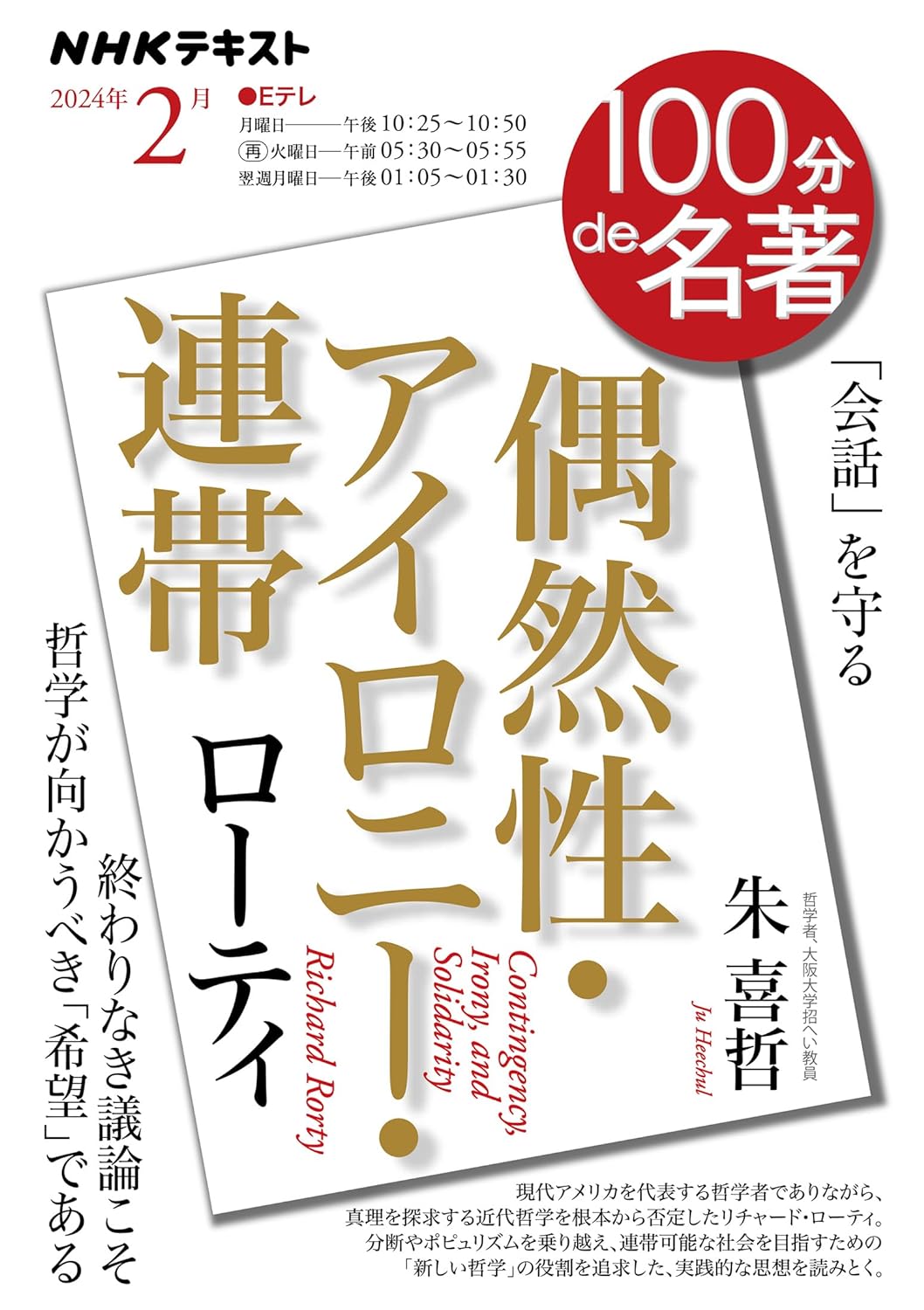
NHK 100 minutes de masterpiece Rorty
Contingency, Irony, and Solidarity. Cambridge: Cambridge University Press, 1989. ・Irony and Solidarity: The Possibility of a Liberal Utopia, Iwanami Shoten, 2000.
Part 1: The man who killed off modern philosophy
This is a story about coincidence. Whether we call an event ``coincidence'' or ``inevitability'' is the same thing, isn't it? Western Europe necessitates being "logical" when explaining events (things). It's a "causal relationship." That logic refers to Indo-European grammar, so what is ``correct'' is what suits their language. Since it is an Indo-European language, India is also under its influence. The ``causality'' that came to Japan with Buddhism is its lineage.
Part 2: Why is “mixing public and private life” bad?
In terms of order, it's the "Irony" episode. But I don't really understand irony.
I don't know what Mr. Shu thinks, but "public" and "private" in Japan are completely different from "public" and "private" in America. How does Mr. Shu, who calls himself the successor of Rorty's will, view the relationship with the first "coincidence"? Japan and America have different cultures. That is what is called "coincidence." Isn't it a contradiction to think that "public" and "private" are common to all cultures and regions? I feel like they think of ``public'' and ``private'' in the same way as ``public opinion and true intention.''
Part 3 Language can even cause genocide
It is only natural that words influence emotions. But I'm tired of the illusion that "words are tools, and it depends on how you use them."
I think it is sincere to have doubts about the word "human rights." And I think this "human" is the problem. Unlike the Japanese word ``hito,'' the word ``homo'' strongly implies ``identity'' (even though ``hito'' is related to ``hitoshii'' (equal)).
``Right'' is also a word that does not exist in Japan. A culture that has a "covenant relationship" with external others or God is a culture with strong subjectivity. ``Legal relations'' (though not ``social contract theory'') is a term that regards human relationships as the relationship between ``self and others.'' In a culture that considers others to be separate entities from the self, there is a strong awareness of "sameness" and "particularity (individuality)."
No. 4 Expand “us” through empathy!
The conclusion of criticizing "human rights" is "we." This means that we can simply expand on "I", but this is a repetition of the basic problem of Western philosophy: "I and Thou." It is natural to have doubts about others and "non-human beings," but it is difficult to think of them as an extension of the "self" and to think that a "liberal" society can be created by expanding the self. , is the center of Western philosophy, and is the complete opposite of the idea of ``the end of philosophy.'' No matter how much we extend "us," there is always an "other" outside of us.
You gave an example of "things that are not human" such as livestock, but humans are not allowed to be killed, but is it okay to kill sheep? Rorty probably says, ``That can't be helped.'' At the end of the 20th century, Western Europe must have doubted the existence of the "other." No matter how much we study the other (external, object), no matter how much we mention it, the more we mention it, the bigger the ``other'' (such as nature) becomes. Therefore, ``emotions'', or ``empathy'', are as important as ``words (logic)''. "Irony (Wikipedia )” is not included. The more Western people become conscious of this, the more they forget about the ``self.'' We tend to forget that it is the self that creates others. We cling to the ``self'' to the end, which creates others and is the cause of unhappiness not only for others but also for ourselves. I can't give it up. No matter how hard I tried, the symbol that I couldn't deny myself was ``I think, therefore I am'' (even if it was ``I doubt myself'').
This is a characteristic of "logic", that is, the structure of Indo-European languages, so it can't be helped as a "coincidence" in the first session. No one can deny it as a regional characteristic or a cultural peculiarity. However, I would like people to stop denying other cultures because of this.
My "feelings" do not allow me to impose this on Semitic or Japanese culture. I guess Rorty is trying to include me, who can't empathize with that, with "us." Although I "sympathize" with what Rorty was trying to do, I am not part of Rorty's "we." When there is no longer a ``me'' or ``we,'' and when there is no longer a need for the word ``solidarity,'' which expresses agency, Rorty's goal is to I hope that something like this will come true.