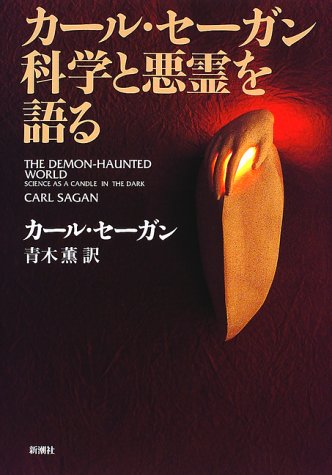
"The Demon Haunted World : Science as a Candle in the Dark",1996
お風呂本(お風呂で読む本)なので、数年かけて読みました(私が所有している本は、カバーもなくボロボロのリサイクル本です)。カール・セーガンの最後の著書です。カール・セーガンの思いがひしひしと伝わってきます。
『人はなぜエセ科学に騙されるのか (新潮文庫)』として再刊され、現在は『悪霊にさいなまれる世界―「知の闇を照らす灯」としての科学 (ハヤカワ・ノンフィクション文庫)』になっています。
カール・セーガンは『コスモス』や『コンタクト』で日本でも有名です。この本の最後の数章は妻との共書になっています。長年ともに歩んできた妻へ向けた遺言なのでしょうか。それとも、セーガン自身の体力がなかったのでしょうか。
科学者として生きた彼の最後の叫びが聞こえてくるような力作(名訳)です。
懐疑的な吟味
アメリカには「宇宙人にさらわれた」という人がたくさんいるそうです。でも、それは「宇宙人」という現代の考えがない時代にありえないのです。昔なら「マリヤ様に会った」でしょう。魔女もそうです。今は「魔女狩り」は行われようもないです。性的虐待も同じでしょう。「臨死体験」については立花隆の論考が面白そうです。
幽霊はどうでしょう。じつは私は怖がりなのですが(暗いところが苦手、幽霊が怖い)、いないことはわかっています。セクハラはどうですか。「ある」と言えそうですね。でも、100年前にはありませんでした。
あると思う、思わない、信じる、信じない、は個人の問題ですが、モラルなく流れる情報を無批判に受け入れるのは社会の問題です。
証明(証拠)の不在は不在の証明(証拠)ではない
この「命題」を知るためだけにでもこの本は読む価値があると思います。
マスコミはワクチン接種の拡大に必死です。新型コロナウィルスの変異株も話題になっています。ワクチンはその変異株にも有効だということになっていますが、ファイザーはその試験をやった上で結果を公表しているのでしょうか。有効だという証拠がないからといって、有効じゃないという証拠ではありません。有効じゃないという証拠がないからということが有効の証拠なわけでもありません。
ファイザーは「旧」新型コロナウィルスに対するワクチンの有効率を95%だと発表しました。これ自体が事実かどうかは問わないとしても、5%の人には効かなかったということです。
コイン投げの「賭け」をしているとしましょう。あなたは10回(100回でも、1000回でもいいけど)、連続して「表」が出ているのを知っているとします。コインに細工はしていないとして、あなたは次に表と裏とどちらに賭けますか。あなたが今までの10回(100回、1000回)の結果を知っているかどうかに関わりなく、次の表裏の出る確率は2分の1ずつ(50%)というのが科学です。
セーガンは科学と非科学を分けるのは、科学的事実の再現性と反証可能性だといいます。そういう意味では、科学というのはより事実に沿った仮説の積み重ねだということです。コインの表と裏の出る確率が正確に2分の1だと証明した人はいるのでしょうか(実験した人はたくさんいます)。
100%の真実
そもそも100%の真実というのがあるのでしょうか。
「1+1=2」というのは真実でしょうか。
ペアノの公理に従えば、「1」という数(記号)の後者(次の数)を「2」という数(記号)とするということです。つまり、「丑年の翌年は寅年だ」というのと同じです。これは「真実」とか「正しい」とか言うことはできないですよね。神はいる(あるいは、いない)と同じで、反証可能性がないのです。ところが、「1+1=2」という式(「壱足す壱は弐」でもいいですが)が出来上がると、それが不変の事実のように思ってしまいます。
亥年の次は子年なので、ペアノの公理は満たしていませんが。
科学者
セーガンは同じ科学者で原水爆を推進したエドワード・テラーを取り上げます。科学者も罪を犯すのです。
私はその力強い筆使いにセーガンの思いを感じます。テラーとの闘いは自分自身との闘いだったのではないでしょうか。テラーを非難するためにいろいろな事実を述べますが、どうもそれは論理(理論)に対して、倫理、道徳、あるいは感情で対抗しているように思えます。科学には国境も人種も関係ない、と言われますが、それは「論理」だからです。論理は「理性」でもありますが、理性は多分に価値判断を含みますよね。だから、論理と倫理は同じものを表しているのですが、科学と倫理は違うものだと思われています。そして、倫理は宗教の領域だとされるのですが、それはとても最近の話です。セーガンは科学者と宗教についてもこの本で言及しています。
彼は、論理で倫理を語ろうとしながら、倫理で論理を語っているのです。
「罪」とか「正義」、「平等」あるいは「民主主義」を論じるときには、そこに価値判断が入ります。そう考えると「宇宙人」や「幻想」、「占星術」、あるいはタイトルにある「悪霊」を語ることも価値判断が入っているのではないでしょうか。セーガンは当時のアメリカ政府(特に共和党)の政策を非難しますが、そこにも「価値判断」が入っています。
私、あなた、みんな
「みんなが幸せになればいい」とか「自由が大切だ」とか言う人を正面から否定することは(ほとんど)ないでしょう。でも、同時にそこには「私の幸せ」「私の自由」が入り込んでいないでしょうか。
「私の幸せ」と「私以外のみんなの幸せ」を天秤にかけるとしたら、どちらが重いですか。難しいですよね。でも、「私の幸せ」と「あなたの幸せ」ならどうですか。そこでは「みんなの幸せ」のような「大義名分」は薄れますよね。
それでも、「みんなの幸せ」や「あなたの幸せ」を取る人は結構多いと思います。でも、それも「〈私〉は」それが正しいと思っている(他の人は思わなくても)という気持ちがあるのではないでしょうか。
人権宣言(Déclaration des Droits de l’Homme et du Citoyen)
どうしてそう思うのか。そういう時代にうまれて、そういう教育をうけてきたからです。フランス人権宣言は「自由、平等」を謳っています。そこで「人」は「人及び市民」です。「人(Homme)」がなにを指すのかはわかりません(「市民(Citoyen)」もわかりません。「人民(Peuple)」もわかりません)。人権宣言を作った(当時の)人がどう考えていたのかはわかりません。あえて現代の感覚で捉えれば、人民は「王侯貴族じゃない人(つまり第三身分の人)」で、「人」は参政権を持ちうる人、つまり、女性や子ども、あるいは納税能力がない人は除外されるのではないでしょうか。市民は「都市に住む人間で、〈人〉以外の人間を含む」というようなことでしょうか。
だから、「所有の権利」を謳います。「所有することができる〈人〉の権利宣言」なのです。所有することができる〈人〉には女性や子どもは当然(?)含まれません。
その「所有」は「明確な私的所有」ではなくて、「個人的所有」だったと思いますが、それがすぐに「私的所有」に転化します。
それまで「王侯貴族」が「所有権」を侵害したことに抗議しているのですが、それまでは「王侯貴族」がすべての財産を「私的所有していた」と考えるのは無理があると思います。王侯貴族が領地を所有し、そこに住む人間を所有していたわけではないのです。たしかに、王侯貴族は領地やそこに住む人を(ある程度)自由に使い、処分をすることができたでしょう(成人男性と女性や子供との関係も同じです)。でも、共有地(入会地)や共有地にもならない土地がたくさんありました。そこは共同体の掟に反しなければ、というか共同体の掟によって共有されていたのです。
そこに「所有権」を持ち込むことによって、第三身分の人たちは少数の「ブルジョア」と大多数の「プロレタリアート」に分離し、所有権を獲得することによって「所有そのもの」を失ったことはみなさんもよくご存知でしょう。そして第三身分は全国民、つまり「全人類」とみなされるのです(『第三身分とは何か』全人類には植民地の人や女性は含まれません)。
私的所有
所有するためには、所有する対象(客体)が必要です。ものを対象化する(客体化する)ことはその反射として自分を主体化することです。「私(自我、あるいは心)」です。
古典ギリシャ以来、西洋はその「私(我)」とはなにかを考えてきました。それは当然のこととして、客体としての自然を考えることでした。それは西洋科学であり、客体としての人間、つまり西洋医学でもあります。
あなたは自分の体を「所有」しているでしょうか。自分の体を対象として見るなら、所有することも可能です。そしてある程度自由に「使用」したり「処分」したりすることも可能です。
「自己への配慮」「自己の統治」です。
自分の体(強いて言えば自分自身)を対象とすることは、他人を対象とすることです。他人の体だけじゃなくて、心も対象とすること、心理学ですね。明確に「他者」を設定するわけです。「私的所有」とは文字通り「(他者とは違う、独立した)〈私〉が所有する」ということです。
他者を「目的」として扱うか、「手段」として扱うか(カント)を考えるためには、他者の存在、そして自己の存在(「我思う故に我あり」デカルト)がまずあります。
〈私〉によって、〈共〉は〈公〉になります。共同体の喪失は近現代の出来事ではなくて〈私〉とセットで発生し、〈共〉は〈公〉に取って代わるのです。
〈共〉の回復
斎藤幸平氏が言うように(『人新世の「資本論」』)〈共(コモン)〉の喪失は、人間から生きる手段を奪います。そしてそれは、私たちが生きる環境の破壊でもあります。
〈共〉の回復方法の一つは、上記の通り、〈公〉を〈共〉に戻すことです。でもそれは〈私〉を無くすことです。西洋科学による地球破壊も無くなるでしょう。でもそれは可能でしょうか。
「自然に帰れ」というのはいつの時代も魅力的な考えです。「懐古主義」は老人だけの考えではありません。
セーガンは原水爆を非難しても、科学を放棄しようとはいいません。似非科学を追放して、本当の科学を取り戻すことが本書の目的だからです。それは私の言葉で言えば、〈公私〉を無くさずに〈共〉を取り戻すことと同じです。〈共〉回復のもう一つの方法ですが、私にはその道が見えないのです。
「悪霊」を呼び戻そうとは思いません。「科学が暗闇を照らすろうそく」になると思いたいです。セーガンの「思い」を引き受けたいと思います。
〈補論〉ーー 老人・女性について
いま、ボーヴォワールの『老い』を読み始めています。「100分de名著」で採り上げられていました。上野千鶴子さんの彼女らしい解説が素晴らしかったです。(最終回は泣いてしまいました。3回観て3回とも泣きました。)
『老い』はまだ100ページほどしか読んでいませんが、最初に老人に対する様々な社会の対応を人類学者の文献から取り上げています。マルセル・モースの『贈与論』は読んだまま、未だに感想を書けないでいます。そのとき改めて詳細を書きますが、その論点の中心は人類学者が様々な「未開人」を記述するとき、現在のフランス語で、西洋論理で「未開人」を解説(解釈)しているということです。
モースは、そこに「贈与」という「関係」を見出すのですが、それは「交換」とは全く違います。経済関係ですらありません。「クラ」は魂でも宗教でもありません。でも、そういう言葉で表す以外にないのです。
「近代の文献学者は、古代の文献の意味を、その原作者の意識においてどうであったのか、その時代の知的環境のなかでどうであったのかという視点に立って、考察しようとする。また、努めてそこにみずからの解釈を介入させない。」(『サンスクリット』ピエール=シルヴァン・フィリオザ著、P.119)
そんな事が可能だとは到底思えないのです。私があなたの思っていること、考えていること、感じていることを理解しようとしたとき、〈私〉抜きには理解できません。理解する主体がないところに「理解」はありません。あるとしてもそれは「理解」とは別のことです。
むしろ「感じる」に近いのではないでしょうか。
理解できない(不可知論)と言っているのではありません。理解するとはそういうことだと言いたいのです。そこにはあなたと私との、言語や記号を始めとする「共通のもの(コード体系、あるいは規則)」を仮定する必要があります。そのコード体系はいくらでも変更できる(対話)し、変わらざるを得ません。私もあなたも、環境も状況も常に変化しているからです。
プラトンの著作の翻訳を少しずつ読んでいますが、そこには「現代の」日本に住んでいる「プラトンとは違う訳者」の存在が入っています。その存在は必然なのです。それを「プラトンとも訳者とも違う私」が読んでいるということです。
話を進める前に、もう一つ最近思ったことがあります。ドラマで女性警察官がとても弱いのです。交際相手からのDVにも逆らえない警察官、犯人を追いかけることもできない交番勤務の警察官などです。「寅三先輩」のように「強いと看做されている」警察官もいますが、やっぱりあんまり強くないです。
体力はないけど、「頭脳明晰な」男性警察官が出てきます。
また、今、オリンピックをやっていますが、競技は男女が別です。男女別でも内容が同じ種目もあれば、規定が違う種目もあります。体操競技なんかを観ていると女性は「シナ」を作って「女性らしさ」を強調しなければならないようです。
オリンピックとパラリンピックは別れています。ハーフや二世の選手が、差別された話も伝わってきます。「体格が良いのは有利だよなあ」というのは、選手の努力を無視した差別でしょうか。それよりも、男女別というのは、女性の方が弱いと宣伝するようなものです。ジェンダー差別を助長すると思います。参加年齢を設けるのも差別ですよね。
ボーヴォワールも上野千鶴子さんも女性の弱い、差別された立場を強調します。女性の問題も老人の問題も「個人」の問題ではなく「社会」の問題なんだと。
女性は(老人は)ほんとうに弱くて虐げられているのでしょうか。その解決は「社会」が変わることで可能なのでしょうか。
私のような「弱い男性」はどうするのでしょうか。それは自己責任だ、とか、しかたないんじゃない?と言われそうです。
解決できないといっているのではありません。「個人」の問題だといっているのでもありません。社会が悪いから「私は不幸なんだ」とか「保護されるべきなんだ」とか思うことがどういうことなのかということです。その思いが本当のことなのか、社会に「思わされて」いるのかを区別することが可能なのか、ということです。
言葉というのは不完全なものです。だから、「悲しい」という気持ちを平気な顔をして100の言葉で表すより、涙を流すほうが伝わります。
「悲しみ」とか「愛」だとかという「何か」が、具体的な「言葉やモノ、あるいは行動」とは別に「そのもの自体としてある」ように思えます。具体的な「りんご」ではなくて「りんごというもの」があるように思います。「猫」という一般名詞がなくて、全部が「タマ」「クロ」「シロ」「ブチ」「ミケ」・・・という固有名詞であったなら、人間の頭はパンクしてしまいます。(『記号論への招待』池上嘉彦著)だから、「猫」という一般名詞があるのでしょうか。プラトンのイデア論もそうですよね。
「美しい「花」がある、「花」の美しさといふ様なものはない」。私が最近良く引用する小林秀雄の文章です(『当麻』)。「〈美〉によって、美しいものは、美しい」(プラトン『パイドン』P.294)とはまったく反対の考え方だと思います。
その言葉や文化・社会、具体性を超えた「なにか」はありそうに思えます。話す言語や住んでいる社会に制約されない「なにか」です。国や歴史や言語を超えた、「人類に共通」なもの、と言い換えてもいいです。性欲や母性本能という言葉では表せないなにか。「親子の愛情」「他者を想う心」「共感力」のようなものが。でも、『老い』を読むと、怪しく思えてきます。「親子の愛情はある」ということと「親子は愛情を持つべきだ」という区別はつかないように思えてくるのです。「老人は性欲をもたない」というのと「老人は性欲を持ってはいけない」、「女性は弱いものだ」というのと「女性は弱くあるべきだ(だから守るべきだ)」との区別も私には付けられません。「現在の日本にいるからそう思うのだ」あるいは「思わされているのだ」という疑いは消えません。私は現在の日本に居て日本の社会で生活をし、日本語で考えたり話たりすることしかできないのであって、紀元前400年のギリシャに住んでギリシャ語で考えることはできないのです。
私は、「タバコは体に悪い」という言説が「タバコを吸うことは悪いことだ」という言説にすり替えられたことを知っています。「高血圧は心臓疾患や脳梗塞を引き起こす」という可能性が「高血圧は治療しなければならない」に変わったこと、「発熱や咳は風邪の症状だ」が「(風邪などの)ウィルスを持っていたら感染している=病気だ」に変わったことも知っています。でも、今の若い人、これから生まれる人にはそれが「あたりまえ(既成事実)」になるのでしょうか。私が「南京大虐殺、従軍慰安婦、強制連行・強制労働、原爆投下・・・」を実感できないように。
「知ること」「理解すること」とはどいういうことなのか。わかりません。「信じること」は可能かもしれません。でも、信じさせられているのかもしれません。セーガンが言う「無責任な」番組(報道なのか、ドラマなのか、ドキュメンタリーなのか、あるいは宣伝なのかすら曖昧な番組)やCMはどんどんエスカレートしています。SNSが社会を変える原動力になる、誰でも自分の意見を世界に発信することができると言う人がいます。でも実際は、何千万人、何億人もの人が書き込むSNSの流れは目で追うことすらできません。その上、表示されるのは自分が好きなものが優先されます。検索サイトで何百万件もヒットしたときに、見るのはせいぜい始めの数ページです。そこに表示されている情報はどういう性格を持っているのでしょうか。
オリンピック番組で、アナウンサーが「120%の実力を出して、頑張ってほしい」と言っていました。実況ではないですよ。原稿がそうなっているのでしょう。選手が大袈裟に言うのならわかります。120%のがあるのなら、150%も200%もあります。でも、それは科学的に間違っていますよね。ワクチンの副作用で死亡した人が10人だったとして(それも検証の必要があります)、コイントスのように50%なんだけど、たまたま「裏」が10回先に出たのかもしれません。95%なんて、根拠にもなんにもなりません。それが、科学(あるいは論理)なのだとしたら、それに振り回されるというのはどういうことなのでしょうか。
それで儲かっている人は、「科学は正しい」と言うでしょう。「あなたもそう思いなさい」と言うでしょう。西洋人、大人、男性等、優位にある者はそう言うことで、優位に立つのです。
わからないのです。考える暇もありません。情報の過多は無情報化のようです。
とりあえず、今わかるのは人類がある程度存続していること、だから私が今存在しているということ、そしてこんなわけもわからないものを書いていることです。それは具体的で、特殊だということです。私には父や母がいる(いた)し、祖父母もいました。そしてその祖父母にも、父母がいて祖父母がいただろうということです。
その祖父母の祖父母が宇宙人に拐われた、あるいは彼ら自身が宇宙人だった可能性はゼロではありませんが。
その祖父母の祖父母の時代の女性たちも(生たきるために)「仕方なく」炊事をし、「いやいや」結婚をし、「やむを得ず」出産・子育てをしていたのでしょうか。「彼女たちは無知だったし、そういう教育を受けなかっただけで、本当は辛かったに違いない。私はそうはなりたくない。」そう思っているのは「教育を受け、知識をもっている」あなた自身なのです。
そう感じるのは、祖先より現在の人間のほうが「進んでいる」という進化論的な思考があります。科学は知識が積み重ねられ、一方方向に発展していくものだ、という思い込みです。私たちは「原始人」よりも進んでいる。当然、猿や犬猫よりも進んでいるという思いです。
「未開人」より進んでいる、という思い、子供よりも進んでいるという思いが「啓蒙」や「教育」の概念になります。
それは、明日は今日よりいいはずだ。良くなくてはならない、という思いに繋がります。明日のために、今日は我慢をするという思いです。それは教育によって身についたものですが、明日がどうなるかはわかりません。
それを担保するのが科学(という論理)です。科学は未来を予測します。そのために科学があるのかもしれません。
予想するためには、明確な「方程式」と、そこに設定する「初期値」が必要です。その初期値は「現在」の「現実」の値です。それがちがっていれば、いくら方程式が優秀でも結果はまったくちがったものになります。予想と実際との違いはフィードバックされ、方程式と初期値が見直されます。科学の再現性と反証可能性とはこのことです。
ところが、「バタフライ効果」と言われるものは、初期値の微妙なズレが大きな計算結果の違いになること表しています。初期値が間違っていなくても、計算のためには有効桁数があります。デジタル計算機では入力及び途中の演算で常に有効桁数が現れます。有限の範囲ですが、有効桁数を増やすことはできますが、有効桁数の増加はそのまま費用の増加と演算時間の激増に繋がり、あっという間に実用の範囲を超えてしまいます。
アナログ計算機ができれば事情は変わってくるでしょうか。費用、つまり「お金」も富を抽象化して、時間と空間を超える象徴として機能します。
予測をしているあいだにも現実は進行していきます。プログラムをしているあいだ、入力をしているあいだ、計算をしているあいだに未来は現在になり、どんどん過去になっていきます。
だから、その間は現在の状態が一定時間続くと仮定しなければなりません。「未来の現在に対する自己同一性」とも言えます。昨日(過去)と今日(現在)の〈私〉の「自己同一性」と、今日(現在)と明日(未来)の〈私〉の「自己同一性」です。
これは、明日のために今日はガマンするということが前提としていたことです。
そのために、つまり、予測する現実を客観視するために、現在を固定視、固定化、静止化しなければならないのです。時間は有限個に分割されます。年を日に、日を時に、時を分に、分を秒に・・・。そして有限個の「ひとコマ」を集めたものが時間として想定されます。現実は「パラパラ漫画」になります。小さな自己同一化の集合体です。全体は部分の寄せ集めとなります。これが映画やテレビの仕組みのアナロジーです。
プログラミングや入力だけじゃなくて、これは字を書いている、あるいは絵を描いているときにも言えます。文字や絵画は「一回性で、常に変化する具体的な現実」を時間的にも空間的にも固定し、超越する行為です。
話し言葉は、発せられた時間の経過のなかで機能し、常に消え去ります。「文字は手紙を書く必要から生まれたとシュメル人は考えていたことになる。」(『シュメル ー人類最古の文明』小林登志子著)つまり、話し言葉との違いは、意思(意図)を時間と空間を超えて存在させるということです。でも、手紙が届いて反応があるまでのあいだに、状況が変化したり、書き手が心変わりをすることだってあります。
「人間は死を恐れる」ということを「生物は生存本能(自己保存本能)があるから」と説明されることがあります。そして死を恐れない行動を「野蛮だ」と思います。野蛮で許されない行為だからこそ「英雄的な行為」ともされます。たしかに、石が飛んできたら、思わず反射的に避けます。それを「生存本能」と呼ぶこと、定義することは可能です。そのことと「意識的に」「死を恐れる」あるいは「死に向かう」ということは全くちがいます。性欲(性本能、自己増殖本能)と「セックスする」「しない」ということは違うのです。それは、文化の問題であり、社会の問題なのです。私は「死を恐れる」というのは自己同一性(アイデンティティー)の問題と強い関係を持っていると考えます。つまり、「文字」との深いつながりを感じるのです。そして西洋科学とのつながりも。
自己同一化は同時に差異化です。主体化と客体化です。その「主=客構造」において、優位は常に主体にあります。だから、「思い込まされている」とか「信じ込まされている」という事はあってはならないのです。詐欺や「洗脳」は犯罪ですが、だまされ、信じ込まされるのはあくまでも主体でなくてはならないのです。そういう文化・社会にとって死や老化(一般的には「自己喪失」)は致命的な事実なのです。
差異化と時間・空間の細分化・固定化とを合わせて「差延」と呼ぶことも可能かもしれません。
未来は不確実です。それはわかっています。人はだれでも死にます。いつか老人となります。それもわかっているのです。死や老化は未来の自分です。しかし私たちの文化・社会は現在は過去に対して優位性を持っています。過去と現在が違うとしても、常に現在(の自分)が「つねに」正しい社会です。
そして現在は未来に対する未完成として現れます。永遠の不満足として現れるのです。常に自己同一化をしながら、つねにそれを廃棄する文化・社会です。自己同一化は未来に対する自己同一化です。現在を延長しようということです。過去に対する自己同一化も行われます。その極端な例として「前世」や「生まれ変わり」があります。それは変人扱いをされながらもなにか心の拠り所となるような気もします。ご先祖様や大自然、つまり失った〈共〉に対する哀愁でしょうか。
現在の自分が正しいとき、優位性を持つときには、他の主体、つまり他者の存在は脅威となります。そこで、「私がこう思っているんだから、他者もこう思っているはずだ」と自己に回収するか、「あいつにはわかんないんだよ(犬畜生だから)」と差別化することになります。
繰り返しになりますが、「昔の女性は辛かった」ということと、「昔の女性は辛かったはずだ」「昔の女性は可哀想だ」と「いま思う」ことは違います。いま、女性は幸せでしょうか。「昔に比べれば幸せだ」というのは「昔は良かった」というのと同じことです。そして、「今は一つの通過点で、もっと良い社会があるはずだ」というのも同じなのではないでしょうか。
言葉を話し、書き、読み、考えていること。私がある(いる)ということ。そう思っていることは、「思わされていること」ではないとしても、自分ひとりで作ったものな何一つないといってもいいでしょう。
そのことを、懐疑的に検討する姿勢、それこそがセーガンが本書でいいたかった事の本質であると思います。
〈書抜〉
「(・・・)批判精神をなくし、願望と事実とを取りちがえているようなとき、われわれは似非科学と迷信の世界にすべり落ちているのだ。」(P.43)
(P.120)__どうして山に登りたいのか。H.K.
エドワード・ギボン『ローマ帝国衰亡史』「奇跡の力をそのまま主張するこの信徒集団に加わろうという気になったのは、しばしば異教徒のなかでも特に好奇心が強く、信じやすい連中だった。」(P.133)「大衆というのは迷信の方が性に合う連中だから、無理やりこれを目覚めさせたところで、快い夢が失われたことを悔やむばかりである。」(P.134)__今や大衆はその想像力すらない。中途半端な啓蒙。半識字。
「しかし、大衆をこうまで見下したギボンの社会的俗物性はいただけない。というのも、悪霊は上流階級の人々をも苦しめたからである。」(同)
(宇宙人にさらわれた?)「文化的要素が重要な役割を演じているのは明らかだろう。」(P.140)
「もしも「記憶の抑圧」や、その「回復」などというものがあるとすれば、そのためには二つの条件が必要だと考えることができる。(1)虐待が実際に起こったこと、そして(2)長いあいだ犠牲者が、虐待などなかったかのようなふりをする必要があったこと、である。」(P.160)__フロイトの悪影響?不幸だと言われたい願望。自分の不幸を他者の責任とすること。本当の敵から目を背けること。
(ラニング「悪魔主義、オカルト、そして邪教の犯罪」)「熱狂的な信者が、神、キリスト、モハメッドの名において犯した犯罪や幼児虐待は、悪魔の名において行われたものよりも多い。」(P.163)__言い得て妙だけど、微妙
「検証できない主張、証明しようのない主張は、たとえそれがどんなにわれわれの心を躍らせ、不思議を思う気持ちをかきたてたとしても、真実としての価値はないのである。」__気をつけよう(笑)。なぜそういうものに心を躍らされてしまうのか。科学少年。探究心。めずらし物好き。科学的探究心と根は同じなのではないか。知ることと信じること。
(今日のコマーシャル文化)「視聴者であるあなたは、疑問など抱かないことになっている。要するに、考えたりせず買いなさい、ということだ。」__これだけ、多量に流れているとCM以外にいかに情報が少ないことか。商品じゃなくてイメージをうるCM。CMをすれば売れる、というより、しなければ売れないのです。勝つ努力じゃなくて、負けないための努力が普通。
第十二章 "トンデモ話"を見破る技術 道具の例
裏づけを取れ、議論のまな板にのせろ、権威主義に陥るな、仮説は複数立てろ、身びいきをするな、定量化しろ、オッカムのかみそり(より単純な方の仮説を選べ)、反証可能性
「証拠の不在は、不在の証拠にあらず」(P.215)
(タレーラン)「民衆にとって唾棄すべきものとなった古い名前の制度に、新しい名前をつけることーーこれは政治家としての重要なテクニックである」(P.219)
「喫煙とガンのあいだに統計的な相関があることはタバコ業界も認めているが、それは相関であって因果関係ではないというのが業界の言い分である。」(P.220)
「しかしたいていの科学者は、フランクリンとはちがって、似非科学のインチキを暴くのが自分の仕事だとは思っていない。ましてや、思い入れたっぷりの自己欺瞞をあばくことなど、ごめんこうむりたいと思っている。科学者という人たちは、このどちらもあまり得意でないことが多いのだ。科学者は自然と格闘するのならお手のもので(自然の謎に渋々降参することもあるにせよ)、おおむね健闘しているといえよう。」(P.231)
「一方、心霊治療師が同業者のインチキを暴くことはまずない。キリスト教会やユダヤ教会は、内部で明らかなインチキが行われても、それを罰することをひどくしぶる。とことん後ろ向きなその姿勢には、愕然とさせられるほどだ。」(P.233)
「信念にいたずらするのは至って簡単だということ、人はいとも簡単に誘導され、信じるものに飢えた孤独な人々をかつぐのはわけもないということだ。」(P.244)
「いいカモになったと認めるのはつらすぎるから、いったん山師に屈したら、もう後戻りはできない。こうして、古いインチキが新しい衣をまとって生き延びるのである。」(P.246)
「自分のまちがいを認めるよりも、強固な証拠をしりぞける方が楽なこともある。それが人間というものなら、その現実は知っておくだけの価値があるだろう。」(P.247)
(占いの言葉)「こんなふうに言われれば、誰だって思い当たる節はあるだろうし、図星だと思う人もいるだろう。そうだとしても不思議はない。われわれはみな人間なのだから。」(P.248)
「懐疑的な吟味は、あくどい商売や"トンデモ話"を根絶やしにするための道具になってくれる。こういう商売の犠牲になるのは、いつも決まって弱い立場の人たち(自分を守る力が弱く、思いやりを必要とし、希望がもてないでいる人たち)だ。また、政治が腐敗しているのに打つ手も打てないでいるような社会では、こと思うにまかせずにいらだっている人や心に隙のある軽率な人、無防備な人たちもいいカモになる。集会、ラジオやテレ(FF)ビ、印刷物、電子メディアによるマーケティングなどが、"トンデモ話"を国民に吹き込むお先棒をかついでしまうこともある。しかし懐疑的な吟味をしていれば、そんな事態にいち早く気づくことができるだろう。(LF)"トンデモ話"や詐欺やペテン、軽率な考えや願望などが「事実」という仮面をかぶって登場するのは、心をめぐる曖昧な助言や記述のたぐいだけではない。不幸なことに、政治、社会、宗教、経済の分野にも、これらはさざなみのように行き渡っているのだ。しかもその事情は、どこの国でも同じなのである。」(P.248-249)
「脳の大きさや頭蓋のでっぱり、IQテストなどから、ある民族やジェンダーがほかよりも「優れている」とする説などもそれだ。」(P.258)__優れている、と同じ、とはどちらも価値判断を含む。同じでなければ「差異」があるが、そこに優劣があるのか。優劣のない差異を考えられるか。東洋と西洋、男と女、犬と猫、表と裏
「われわれはみな、欠点を抱えた時代の子なのだ。未来の基準でわれわれを裁くのは、はたして公平なことだろうか?現代の習慣のなかには、後世の目には野蛮に映ることもあるにちがいない。たとえば、幼い子供を親から引き離して一人で眠らせたり、大衆の人気を得て高い政治的地位につくために国粋主義的情熱を煽ったり、ペットを飼い、動物を食べ、チンパンジーを檻に入れたり、大人が陶酔薬を使うのを犯罪とみなしたり、子供を無知のまま大人にすることも野蛮だとみなされるかもしれない。」(P.264)
「しかし、ダーウィンがジョン・D・ロックフェラーやアドルフ・ヒトラーを生み出したわけではないのだ。十九世紀の資本主義を説明するには、貪欲さ、産業革命、自由企業制、金持ちが掌握していた政府の腐敗をもちだすほうが適切だろう。ヒトラーが政権を握った理由を説明するためには、自民族中心主義、外国人排斥主義、ドイツにおける反ユダヤの長い歴史、ベルサイユ条約、ドイツの育児習慣、インフレ、不況を持ち出す方が適切だ。ダーウィンがいてもいなくても、同様の出来事が起こっただろう。」(P.265)__セーガンの歴史観。でも、セーガンにもダーウィンにも共通しているのは進歩主義。ヒトラーについても同じ。セーガンは今が最高という意識はないが、科学の発展についてはこの本のような制限を求めつつも認めている。ヒトラーも「合理主義」の一つの結晶だと思う。
(P.269)__知れば知るほど言えなくなる。最先端科学はそういうもの。仕事も。
「しかし人間の感情には、人間にしかない特別なものなどないのである。一方、量的にも質的にも、科学のようなものをもつ動物は人間だけだ。だとすれば、科学は「人間性を奪う」どころか、むしろ人間的とも言えるのではないだろ(FF)うか。」(P.270-271)
「CIA長官は一九九五年に「無制限の秘密主義は無制限に腐敗する」と述べた。」(P.291)
「われわれの社会でも、いつか毒矢を安全な場所に隠すのは、やはり女性たちーーそして子どもたちーーなのだろうかと。」(P.293)
「こういう切り替えをしている人は科学者のなかにもいて、そういう人は、疑うことを旨とする科学の世界と、信じることを旨とする信仰の世界とを、軽やかに行き来している。だが、この二つの世界の食いちがいが大きくなるにつれて、どちらの世界も居心地が悪くなり、良心が痛みはじめるのである。」「しかし、科学をこまぎれにして、都合のいいところでは持ち出し、具合の悪いとこでは無視するというわけにはいかない。なぜなら、ここでもやはり、われわれはそれができるほど賢くはないからだ。」(P.296)
「かつては(地球規模のニュースメディアでは今でもたいていそうだが)、空中浮遊するグルや、地球に飛来した宇宙人や、チャネラーや心霊治療師がメディアを賑わしても、まったく批判されなかった。どうやらテレビ局や新聞や雑誌には、前にも似たようなインチキがあったことを覚えておくシステムがないらしい。サイコップは、声の大きさでは到底太刀打ちできないけれど、似非科学に対するだまされやすさへの対抗勢力になっているのだ(このだまされやすさは、多くのメディアの第二の本性であるらしい)。(LF)私のお気に入りのひとこまマンガに、こんなものがある。占い師がカモである客の手のひらを見ながら、「あなたはだまされやすいですね」と重々しく告げている図だ。」(P.299)
(P.315)__こちらからあちらの文化を見るのではなく、あちらからこちらの文化を見る「視点」(目の文化)
「科学は、人が生き延びるための手段であり、われわれが生まれながらにもつ権利なのだ。無関心や不注意や無能や、懐疑主義への不安から、子供たちを科学から遠ざけるとき、われわれは子供たちの手から、将来生きるために必要な道具を取り上げているのである。」(P.316)
「まず、出る杭は打たれるという仲間うちのプレッシャーがあること(スポーツは別だが)。それに、社会が子供たちに対してすぐに手に入る満足ばかり教えていること。また、科学や数学をやってもスポーツカーは買えないという印象があること。それから、生徒たちがはじめから期待されていないこと。されに、科学や技術について知的な議論をしたところで(あるいは学ぶことそれ自体にも)報いがなく、手本となるような役割モデルがいないことも原因の一つだ(FF)ろう。」(P.318-319)
「大人だって知らないことがあると認めてもいいではないか。」(P.319)
「二歳児が親に浴びせかける「どうして」の連呼はこれから除外する。あれはおそらく、大人の行動を支配しようとしてやっているのだろう。」(P.320)
「無気力で好奇心のない、批判精神も想像力ももたない高校三年生を作らないでほしい。」(P.314)
「私はこれに、懐疑的思考と、不思議さに驚嘆する感(FF)性とをつけ加えたい。(LF)それと同時に、特殊な才能や技能をもつ子供たちは、大切に育んでその力を伸ばしてやらなくてはならない。彼らは国の宝である。「才能に恵まれた」子供たちのための意欲的なプログラムは、ときとして「エリート主義」とのそしりを受ける。では、フットボールや野球やバスケットボールの代表選手を特訓したり、学校感の教義体系を模様したりするのはエリート主義ではないのだろうか。これだって結局は、才能に恵まれた選手しか参加できないではないか。アメリカ中で通用しているこのダブル・スタンダードのために、われわれは自分の首を絞めているのだ。」(P.342-343)
(P.349)__イサカアワー、地域通貨
「だからこそ奴隷所有者は、奴隷が見たり聞いたり、考えたるすることを取り締まったのである。不公平な社会においては、本を読んだり、批判的な考え方をしたりすることは、社会を転覆さえしかねない危険なこととされるが、その理由はまさにここにある。」(P.351)__今の日本でも同じ。
「書物は、われわれがこの世界を理解し、民主的な社会に参加するためのカギなのだ。」(P.353)
「そして、読み書きがまったくできなかったり、かろうじて読み書きができる程度の人では、監獄に入る率がずっと高いのだ。(これは相関関係があるということにすぎず、ここから因果関係を引き出すという誤りを犯してはならない。)」(同)
「「お前は馬鹿だから勉強してもだめだ」と言われ続け(「きみはかっこいいから勉強なんか似合わない」と言われることにも同じような効果がある)、誰もそれを否定してくれなければ、こんなたちの悪い意見を受け入れてしまったとしても不思議はない。」(P.354)
「貧困、無知、希望のなさ、自己評価の低さという歯車がかみ合って、悪循環する永久機関を作りあげ、何世代(FF)にもわたって人々の夢を打ち砕いている。」(P.358-359)
「パターン化した『〇〇を追う』シリーズでは、冒頭で「この番組はバランスの取れた見方を提示するものではない」という責任放棄が宣言される。」(P.365)__宣言されるだけまだいい。CMでは「個人の感想です」などの文字が小さく現れる。
「医学やテクノロジーはいくらか取り上げられるものの、科学が登場することはほとんどない。」(P.367)
「人はジェンダーや性的嗜好、生まれ月によってステレオタイプ化され、職業もステレオタイプ化されている。どんなに好意的に解釈しても、ステレをタイプ化することは一種の知的怠慢だろう。」(P.370)
「それを見落として、原因と結果を混同し、女性科学者がいないといって女性をけなしていたのだ。」「ときには被差別者自身にさえ、それとわからないこともある。」「すなわち、女性が疑うことをしないようにしむけ、懐疑的に考えるための教育すらも与えないのだ。」(P.371)
「われわれに中途半端な情報と娯楽をもたらすテレビもそうである。」(P.382)
「科学と民主主義はどちらも、実験による批判を積極的に受け入れる思想である。」(P.394)
(P.397-401)__魔女(=新型コロナウィルス)
「テレビはどの家庭にもあり、しかも批判的な考え方はすたれている。こんな状況下では、秘密警察が暗躍するまでもなく、社会の記憶を作り変えてしまえるだろう。」「ごく少数の人たちが、ニュース記事や歴史の本や影響力のある映像を支配し、それによって国民全体の考え方を変えてしまうような事態のことである。」「それまでイラクの独裁者サダム・フセインはアメリカ国民にとって普段は意識にものぼらない同盟者でしかなかった(アメリカは同盟国であるイラクに対して、物資、テクノロジー、兵器、はては偵察衛星によるデータまで提供していたのだ)。それが突如として、世界を相手に脅しをかける怪物に成り代わったのである。」(P.405)
「私はこれに、自由な思考は民主主義を打ち立てるための必要条件であるが、十分条件ではないと付け加えたい。」(P.410)
「市民が誤りに陥らないようにするのは政府の役目ではない。しかし、政府が誤りに陥らないようにするのは市民の役目である。」(合衆国最高裁判所判事ロバート・H・ジャクソン)(P.411)
「そして、教育にかかるコストは、無知にかかるコスト、すなわち政治を狼の手に委ねてしまったために生じるコストにくらべれば、取るに足りないものでしかないと主張した。(LF)脅されて人の言いなりになったりしないことは、国民の義務である。移民が市民権を得るときの誓いや、学生たちがよく口にする誓の中に、「指導者の言うことはいちいち疑います」と言った言葉が含まれていたらどんなに素晴らしいだろう。それこそはトマス・ジェファーソンの願いだったはずだ。それに加えて、みんながこんな宣言をしたらどうだろう。「自分の頭で判断することを誓います。人の意見に流されないよう努力することを誓います。そのためにも、自らを教育していくことを誓います」と。」(P.416)
「少しの秩序を手に入れるために、少しの自由を手放そうとする社会は、そのどちらをも失うことになるでしょう。それに、そんな社会は、秩序にも自由にも値しないのです」(トマス・ジェファーソン)(P.420)
「つまり創造とは、足かせをはずす行為なのだ。」(同)
「集会の権利があっても、なにを抗議していいのかわからないのでは意味がないし、選挙権が広く行き渡っても、投票率が半分以下では意味がない。」(P.422)
〈メモ〉
労働者は反抗するものなのでしょうか、革命を起こすべきものなのでしょうか。私たちは環境を守るべきなのでしょうか。
「女性の気持ちはわからない」ということと「他人の気持ちはわかるはずがない」ということは違います。
⟨impressions⟩
"The Demon Haunted World: Science as a Candle in the Dark & quot ;, 1996
It's a bath book (a book to read in the bath), so I spent several years reading it (the book I own is a tattered recycled book without a cover). This is Carl Sagan's last book. The thoughts of Carl Sagan are transmitted.
"& lt; a href = & quot; https://www.amazon.co.jp/dp/4102294031/?tag=charmedias-22" target = & quot; _blank & quot; & gt; It was republished as "Noka (Shincho Bunko) & lt; / a & gt;" and is now "& lt; a href = & quot; https://www.amazon.co.jp/dp/4150503567/?tag=charmedias-22" target = & quot; _blank & quot; & gt; The world of evil spirits-Science as a "light that illuminates the darkness of knowledge" (Hayakawa Nonfiction Bunko) & lt; / a & gt; ".
Carl Sagan is also famous in Japan for "Cosmos" and "Contact". The last few chapters of this book are co-authored with his wife. Is it a will for my wife who has been with me for many years? Or was Sagan not physically fit?
It's a masterpiece that you can hear his last cry as a scientist.
Skeptical scrutiny
There are many people in the United States who say they have been kidnapped by aliens. But that is not possible in an era without the modern idea of "aliens." In the old days, I would have met Mary. So is the witch. "Witch hunting" is unlikely to take place now. Sexual abuse would be the same. Takashi Tachibana's discussion about "near-death experience" seems to be interesting.
How about ghosts? I'm scared (I'm not good at dark places, I'm scared of ghosts), but I know I'm not. How about sexual harassment? You can say "yes". But it wasn't 100 years ago.
I think, don't think, believe, disbelieve is an individual problem, but it is a social problem to accept information that flows without morals without criticism.
Absence of proof (evidence) is not proof (evidence) of absence
I think this book is worth reading just to know this "proposition".
The media is desperate to expand vaccination. Mutants of the new coronavirus have also become a hot topic. The vaccine is supposed to be effective against the mutant strain, but is Pfizer doing the test and publishing the results? Just because there is no proof that it is valid does not mean that it is not valid. The lack of evidence that it is not valid does not mean that it is valid.
Pfizer has announced a vaccine efficacy rate of 95% against the "old" new coronavirus. Whether this is true or not, it didn't work for 5% of people.
Suppose you are making a "bet" on a coin toss. Suppose you know that the "table" appears 10 times in a row (100 times or 1000 times). Assuming you haven't crafted the coins, which side do you next bet on, front or back? Whether or not you know the results of the 10 times (100 times, 1000 times) so far, the science is that the probability of the next front and back is half (50%).
Sagan says that what separates science from non-science is the reproducibility and falsifiability of scientific facts. In that sense, science is a more factual accumulation of hypotheses. Has anyone proved that the odds of the front and back of a coin being exactly half (many have experimented)?
100% truth
Is there 100% truth in the first place?
Is it true that "1 + 1 = 2"?
According to Peano's axioms, the latter (next number) of the number (symbol) "1" is the number (symbol) "2". In other words, it is the same as saying, "The year after the year of the ox is the year of the tiger." You can't say this is "truth" or "correct". It is the same as having (or not having) God, and there is no possibility of falsification. However, when the formula "1 + 1 = 2" ("Ichi add Ichi is 2" is fine) is completed, it seems to be an unchanging fact.
Peano's axioms are not met because the year after the year of the pig is a child year.
Scientist
Sagan takes up Edward Teller, the same scientist who propelled the atomic bomb. Scientists also sin.
I feel Sagan's feelings for his powerful brushstrokes. Perhaps the fight against Teller was a fight against himself. I'll state a lot of facts to blame Teller, but it seems to be ethical, moral, or emotional opposition to logic. It is said that science has nothing to do with borders or race, because it is "logic." Logic is also "reason," but reason probably involves value judgment, isn't it? So logic and ethics represent the same thing, but science and ethics are thought to be different. And ethics is said to be the realm of religion, which is a very recent story. Sagan also mentions scientists and religions in this book.
He is talking about logic with ethics while trying to talk about ethics with logic.
When discussing "sin," "justice," "equality," or "democracy," value judgment comes into play. With that in mind, talking about "aliens," "illusions," "astrology," or "evil spirits" in the title may also include value judgment. Sagan blames the policies of the US government (especially Republicans) at the time, but it also contains "value judgments."
I, you, everyone
There is (almost) no head-on denial of anyone who says, "I wish everyone was happy" or "freedom is important." But at the same time, isn't "my happiness" and "my freedom" intruding into it?
Which is heavier if you weigh "my happiness" and "the happiness of everyone except me"? It's difficult, isn't it? But what about "my happiness" and "your happiness"? There, "the cause" such as "everyone's happiness" fades.
Still, I think there are quite a lot of people who take "everyone's happiness" or "your happiness". However, I think there is a feeling that "I" thinks it is correct (even if no one else thinks).
Declaration of Human Rights (Déclaration des Droits de l’ Homme et du Citoyen)
Why do you think so? I was born in such an era and received such education. The French Declaration of Human Rights states "freedom, equality". So "people" are "people and citizens". I don't know what "Homme" means (I don't know "Citoyen", I don't know "Peuple"). I don't know what the (at that time) person who made the Declaration of Human Rights thought. If you dare to think in a modern sense, the people are "people who are not royal aristocrats (that is, people of third status)", and "people" are people who can have suffrage, that is, women, children, or people who do not have the ability to pay taxes. Isn't it excluded? Do citizens say, "Human people living in the city, including people other than" people "?"
That's why we claim "ownership rights". It is a "declaration of the rights of a" person "who can own it." Of course, women and children are not included in the "people" that can be owned.
I think that "ownership" was not "clear private property" but "private property", but it soon turns into "private property".
Until then, the "royal aristocrats" had protested the infringement of "ownership", but until then, the "royal aristocrats" had "privately owned" all their property. I think it's impossible to think about it. The royal aristocrats owned the territory, not the humans who lived there. Indeed, the royal aristocrats would have been (to some extent) free to use and dispose of the territory and its inhabitants (as well as the relationship between adult men and women and children). However, there were many common lands (admission lands) and lands that could not be common lands. It was shared by the rules of the community, if it did not violate the rules of the community.
By bringing "ownership" there, third-estate people are separated into a small number of "bourgeois" and the majority of "proletariats", and by acquiring ownership, "ownership itself" You all know that you lost. And the Third Estate is considered to be the whole nation, or "all mankind" ("What is the Third Estate"? All mankind does not include colonial people or women).
Private property
In order to own, you need to own the object (object). To target (objectify) things is to make yourself the subject as a reflection of them. It is "I (ego or mind)".
Since classical Greece, the West has been thinking about what that "I" is. It was, of course, to think of nature as an object. It is Western science, and human beings as objects, that is, Western medicine.
Do you "own" your body? If you look at your own body, you can own it. And it is also possible to "use" and "disposal" to some extent.
"Consideration for self" and "government of self".
To target your body (or yourself, to put it bluntly) is to target others. It's psychology that targets not only the body of others but also the mind. It clearly sets "others". "Private property" literally means "owned by" I "(independent, unlike others)."
In order to consider whether to treat others as "purpose" or "means" (Kant), there is the existence of others and the existence of self ("I am because I think" Cartesian). ..
By "I", "Co" becomes "Public". The loss of the community occurs not as a modern event but as a set with "I", and "Co" replaces "Public".
Recovery of "Co"
As Mr. Kohei Saito says ("Human New World's" Capital Theory "") << The loss of (Common) deprives humans of the means to live. And it is also the destruction of the environment in which we live.
One of the ways to recover "Co" is to return "Public" to "Co" as described above. But that is to get rid of "I". The destruction of the earth by Western science will also disappear. But is that possible?
"Return to nature" has always been a fascinating idea. "Nostalgia" is not just an old man's idea.
Sagan does not want to abandon science, even if he blames the atomic bomb. This is because the purpose of this book is to expel pseudoscience and regain true science. In my words, it's the same as regaining "common" without losing "public and private". Another way to recover, but I can't see the way.
I don't want to bring back the "evil spirit". I want to think that science will be a candle that illuminates the darkness. I would like to take on Sagan's "thoughts".
{Appendix} --- About old men and women
Now I'm starting to read Beauvoir's "Old". It was picked up in "100 Minutes de Meicho". Chizuko Ueno's commentary like her was wonderful. (She cried in the final episode. She watched three times and cried three times.)
Although I have only read about 100 pages of "Aging", I first take up various social responses to the elderly from the anthropologist's literature. I have read Marcel Mauss's The Gift, but I still can't write my impressions. At that time, I will write the details again, but the center of the issue is that when anthropologists describe various "barbarians", they explain (interpret) "barbarians" in Western logic in the current French language. is.
Morse finds a "relationship" called "gift" there, which is completely different from "exchange". Not even economic. "Kura" is neither a soul nor a religion. However, there is no choice but to express it in such words.
"Modern philologists have taken the meaning of ancient literature from the perspective of what it was in the consciousness of its original author and in the intellectual environment of that era. , I will try to consider it. Also, I will try not to intervene in my own interpretation. "(" Sanskrit "Pierre = Sylvain Filiosa, p.119)
I don't think it's possible. When I try to understand what you think, think, and feel, you can't understand without "I". There is no "understanding" where there is no subject to understand. It is different from "understanding", if any.
Isn't it more like "feeling"?
I'm not saying that I don't understand (agnosticism). I want to say that understanding is that kind of thing. It is necessary to assume "common things (code system or rules)" between you and me, including languages and symbols. The code system can be changed (dialogue) as much as you like, and it has to change. Because I and you, the environment and the situation are constantly changing.
I'm reading the translations of Platon's writings little by little, and there is a "translator different from Platon" who lives in "modern" Japan. Its existence is inevitable. It means that "I, who is different from Platon and the translator," is reading it.
Before proceeding with the story, I have another recent thought. The female police officer is very weak in the drama. There are police officers who can not resist DV from dating partners, police officers who work in police boxes who can not chase the criminal, etc. There are police officers who are "considered to be strong" like "Torasan Senpai", but they are not very strong.
There are male police officers who are not physically fit but have a "clear mind".
Also, I'm playing the Olympics now, but the competition is different for men and women. Some events have the same content by gender, while others have different regulations. When watching gymnastics, it seems that women have to make "China" to emphasize "femininity".
The Olympics and Paralympics are separated. The story of half and second generation players being discriminated against is also conveyed. Is "good physique is advantageous" a discrimination that ignores the efforts of the players? Rather, gender separation is more like advertising that women are weaker. I think it promotes gender discrimination. It is also discriminatory to set the participation age.
Beauvoir and Chizuko Ueno emphasize the weak and discriminated position of women. The problem of women and the problem of old people are not "individual" problems but "social" problems.
Is the woman (old man) really weak and oppressed? Is the solution possible by changing the "society"?
What about a "weak man" like me? It's a self-responsibility, isn't it? Is likely to be said.
I'm not saying it can't be solved. I'm not saying it's an "individual" issue. What does it mean to think "I am unhappy" or "should be protected" because society is bad? Is it possible to distinguish between the true feelings and whether they are "thought" by society?
Words are incomplete. Therefore, it is better to shed tears than to express the feeling of "sadness" with a calm face and 100 words.
It seems that "something" such as "sadness" or "love" is "itself" apart from the concrete "words, things, or actions". I think there is an "apple" instead of a specific "apple". If there is no general noun "cat" and all are proper nouns such as "tama", "kuro", "shiro", "buchi", "mike", etc., the human head will be flat. ("Invitation to Symbolism" by Yoshihiko Ikegami) Therefore, there is a general noun "cat", right? Is it? The same is true of Platonic's theory of ideas.
"There is a beautiful" flower ", there is no such thing as the beauty of a" flower "." This is Hideo Kobayashi's text that I often quote recently ("Toma"). The opposite of "Beauty is beautiful by" Beauty "" (Platon "Phaedon" P.294). I think it's a way of thinking.
It seems that there is something that goes beyond that language, culture, society, and concreteness. It is "something" that is not restricted by the language you speak or the society in which you live. It can be rephrased as something that is "common to all humankind" that transcends nations, history, and languages. What can't be expressed in terms of libido and maternal instinct? Something like "parent-child affection," "thinking about others," and "empathy." But when I read "Old", I feel suspicious. It seems indistinguishable between "parents and children have affection" and "parents and children should have affection". The distinction between "old man has no libido" and "old man must not have libido", "woman is weak" and "woman should be weak (so should be protected)" Can't be attached to me. The suspicion that "I think so because I am in Japan today" or "I think so" does not disappear. I live in Japan today, live in Japanese society, and can only think and speak in Japanese, not in Greece, 400 BC, in Greek.
I know that the discourse that "cigarettes are bad for you" has been replaced by the discourse that "smoking is bad". The possibility that "high blood pressure causes heart disease and cerebral infarction" has changed to "high blood pressure must be treated", and "fever and cough are symptoms of a cold" but "have a virus (such as a cold)" I also know that it has changed to "I'm infected = I'm sick." But will it be "natural (established fact)" for young people today and those who will be born in the future? Don't let me realize "Nanjing Massacre, comfort women, forced labor / forced labor, dropping the atomic bomb ...".
What do you mean by "knowing" and "understanding"? I do not know. "Believe" may be possible. But it may be made to believe. Sagan's "irresponsible" programs (news, dramas, documentaries, or even promotional ones are ambiguous) and commercials are escalating. Some people say that SNS is the driving force for changing society, and anyone can send their opinions to the world. But in reality, you can't even follow the flow of SNS written by tens of millions or hundreds of millions of people. What's more, what you like is prioritized. When you hit millions of search sites, you'll only see the first few pages at best. What kind of character does the information displayed there have?
On the Olympic program, the announcer said, "I want you to do your best with 120% ability." It's not the actual situation. The manuscript may be like that. I know if the players exaggerate. If you have 120%, you have 150% and 200%. But that's scientifically wrong, isn't it? If 10 people died from the side effects of the vaccine (which also needs to be verified), it's 50% like a coin toss, but it may happen that the "back" came out 10 times earlier. 95% is no basis. If it's science (or logic), what does it mean to be swayed by it?
Those who make money from it will say, "Science is right." You will say, "Think so too." Westerners, adults, men, and other people who have an advantage will have an advantage by saying that.
I don't know. I have no time to think. Excessive information seems to be non-information.
For the time being, what I know now is that human beings have survived to some extent, so that I am now, and that I am writing something that I do not understand. It's concrete and special. I had (was) a father and mother, and I also had grandparents. And that grandparent would have had a parent and a grandparent.
It's possible that the grandparents' grandparents were kidnapped by aliens, or they were aliens themselves.
Was the women of their grandparents' days also cooking "unavoidably" (to survive), getting married "no", and giving birth and raising children "unavoidably"? .. "They were ignorant, and it must have been really painful just because they didn't get that education. I don't want to." I think "educated and knowledgeable" you It's myself.
I feel that way, because of the evolutionary thinking that human beings are "advanced" than their ancestors. The belief that science is one in which knowledge is accumulated and develops in one direction. We are more advanced than "primitives". Naturally, I think it is more advanced than monkeys and dogs and cats.
The concept of "enlightenment" and "education" is the idea of being more advanced than the "barbarian" and the idea of being more advanced than the child.
It should be better tomorrow than today. It leads to the feeling that it must be good. I will put up with it today for tomorrow. It's learned through education, but I don't know what will happen tomorrow.
Science (the logic) guarantees that. Science predicts the future. There may be science for that.
In order to make a prediction, you need a clear "equation" and an "initial value" to set there. Its initial value is the "current" "reality" value. If it is different, no matter how good the equation is, the result will be completely different. Differences between expectations and reality are fed back and the equations and initial values are reviewed. This is the reproducibility and falsifiability of science.
However, what is called the "butterfly effect" indicates that a slight deviation in the initial value makes a big difference in the calculation result. Even if the initial value is correct, there are significant digits for the calculation. In a digital computer, the number of significant digits always appears in the input and the calculation in the middle. Although it is a finite range, it is possible to increase the number of significant digits, but the increase in the number of significant digits directly leads to an increase in cost and a drastic increase in calculation time, and it quickly exceeds the practical range.
Will the situation change if an analog computer is created? Cost, or "money," also abstracts wealth and acts as a symbol that transcends time and space.
Reality progresses while making predictions. While programming, typing, and calculating, the future becomes the present and becomes more and more past.
So you have to assume that the current state lasts for a period of time during that time. It can also be called "self-identity with respect to the present in the future." Yesterday (past) and today (present) "I" "self-identity" and today (present) and tomorrow (future) "I" "self-identity".
This was based on the premise that we would be sick today for tomorrow.
For that reason, that is, in order to objectively view the reality to be predicted, the present must be fixed, fixed, and stationary. Time is divided into a finite number. Year to day, day to hour, hour to minute, minute to second ... And the time is assumed to be a collection of a finite number of "human frames". The reality is a "flip book". It is a collection of small self-identifications. The whole is a collection of parts. This is an analogy of how movies and television work.
Not only for programming and input, this is also true when writing or drawing. Letters and paintings are acts that transcend the "one-time, ever-changing concrete reality" that is fixed in time and space.
Spoken language works over the course of time it is spoken and always disappears. "The Sumerians thought that letters were born from the need to write letters." ("Sumer-the oldest civilization of mankind ”by Toshiko Kobayashi) In other words, the difference from spoken language is that the intention (intention) exists beyond time and space. However, the situation may change and the writer may change his mind before the letter arrives and there is a reaction.
"Human beings are afraid of death" is sometimes explained as "because living things have a survival instinct (self-preservation instinct)". And I think that behavior that is not afraid of death is "barbaric." It is also called a "heroic act" because it is a barbaric and unforgivable act. Certainly, if a stone flies, avoid it reflexively. It is possible to call and define it as a "survival instinct." That is completely different from "consciously," "fearing death," or "going to death." There is a difference between "having sex" and "not having sex" with frigidity (sexual instinct, self-renewal instinct). It's a cultural issue, a social issue. I think that "fearing death" has a strong relationship with the issue of self-identity. In other words, I feel a deep connection with "characters". And the connection with Western science.
Self-identification is differentiation at the same time. Subjectivity and objectification. In that "main = customer structure", the superiority is always in the subject. Therefore, there should be no such thing as "believed" or "believed". Fraud and "brainwashing" are crimes, but it must be the subject who is deceived and believed. Death and aging (generally "self-loss") are fatal facts for such cultures and societies.
It may be possible to collectively call differentiation and time / space subdivision / fixation as "différance".
The future is uncertain. I know that. Anyone dies. He will be an old man someday. I know that too. Death and aging are the future self. However, our culture and society now have an advantage over the past. Even if the past and the present are different, the present (self) is always the right society.
And now it appears as an incomplete for the future. It manifests itself as eternal dissatisfaction. It is a culture and society that always abandons it while always self-identifying. Self-identification is self-identification for the future. It means to extend the present. Self-identification with respect to the past is also performed. Extreme examples are "previous life" and "reincarnation." Although it is treated as an eccentric, I feel that it can be a source of my heart. Is it melancholy for your ancestors and nature, that is, the lost "common"?
When you are right and have an advantage, the existence of another subject, that is, another person, poses a threat. So, either collect it to yourself, saying, "I think this, so others should think this," or differentiate it from "I don't know him (because he's a dog brute)." Become.
Repeat, "old women were painful" and "old women should have been painful" "old women are pitiful" and "think now" are different. .. Are women happy now? "I'm happier than I used to be" is the same as "I was good in the past." And I think it is the same as saying, "Now there should be a better society at one passing point."
Speaking, writing, reading and thinking. That I am. It can be said that what you think is not "what you think", but nothing that you made by yourself.
I think that the attitude of skeptical consideration of that is the essence of what Sagan wanted to say in this book.
[著者等(プロフィール)]
セーガン,カール
1934年ニューヨーク生まれ。シカゴ大学大学院で博士号を取得。専攻は惑星科学。コーネル大学天文宇宙科学科教授を務めながら、同大電波物理宇宙研究センター惑星研究所長も兼任した。1978年、『エデンの恐竜』など宇宙・天文に関する一連の著作でピュリッツァー賞を受賞。1980年に発表された『コスモス』は空前のベストセラーとなる。「核の冬」理論の提唱者としても名高い。1996年12月死去
青木/薫
1956年生、京都大学理学部卒業、同大学院修了。理学博士、翻訳家
内容(「BOOK」データベースより)
宇宙物理学者からの最後のメッセージ!人はなぜ似非科学(=トンデモ話)に騙されるのか。超能力、火星人、心霊術…ロズウェル事件やカルロス事件など数々の実例を挙げ、エセ科学の「闇」を徹底的に撃つ―惜しくも亡くなったセーガン博士が精魂傾けた、渾身の長編科学エッセイ。
内容(「MARC」データベースより)
超能力、火星人、心霊術…人はなぜエセ科学に騙されるのか。ロズウェル事件やカルロス事件など数々の実例を挙げ、エセ科学の「闇」を徹底的に撃つ。惜しくも亡くなった宇宙物理学者による長編科学エッセイ。
宇宙物理学者からの最後のメッセージ!人はなぜ似非科学(=トンデモ話)に騙されるのか。超能力、火星人、心霊術…ロズウェル事件やカルロス事件など数々の実例を挙げ、エセ科学の「闇」を徹底的に撃つ―惜しくも亡くなったセーガン博士が精魂傾けた、渾身の長編科学エッセイ。
内容(「MARC」データベースより)
超能力、火星人、心霊術…人はなぜエセ科学に騙されるのか。ロズウェル事件やカルロス事件など数々の実例を挙げ、エセ科学の「闇」を徹底的に撃つ。惜しくも亡くなった宇宙物理学者による長編科学エッセイ。