Punctuation
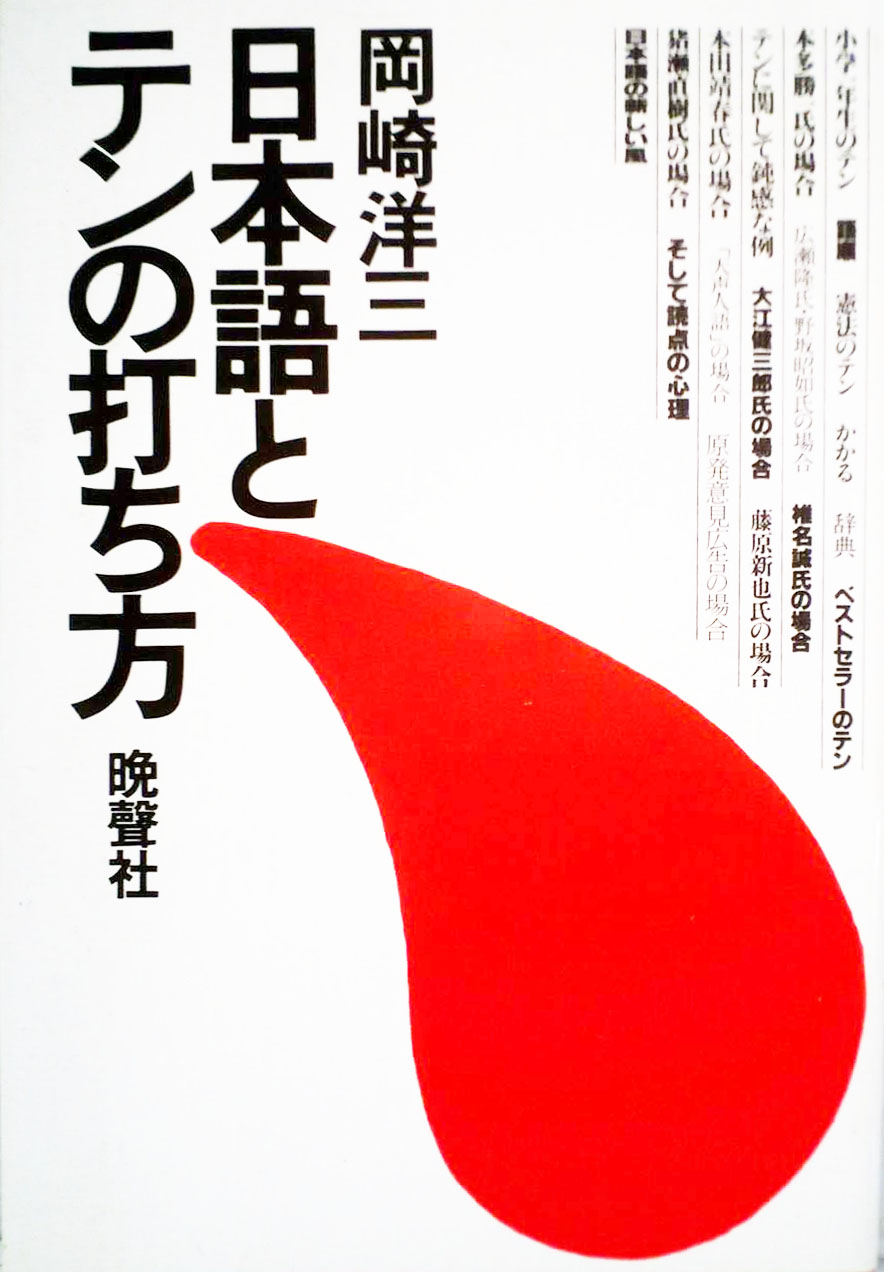
Punctuation is ``.'' and comma is ``,''. This book is a reading point book.
I borrowed it from the library. I didn't go to borrow this book, but it looked interesting so I borrowed it and read it. I don't think this kind of encounter is an online bookstore ("recommended" is displayed, but it's different). I don't know about the author. Are you a Japanese language pedagogy?
Functions of Ten
The author lists five functions (P.109)
- Square of messages
- Emphasis on words
- Clarify word context
- Incorporate time course
- Regulate tone and rhythm
Punctuation for Emphasis
I've only recently started writing, and I understand punctuation to some extent, but I don't know how to type punctuation. I hit a lot of random shots. The feeling of wanting to be understood precedes and makes me want to put commas in each word. This is what I call "emphasis points" in this book. I added " " and < > to "important words", but it is to assert (emphasize) that it has a unique meaning, not a normal meaning. But when I saw someone write "that kind of sarcastic writing", I realized that I felt the same way. I think, "If you want to express your own meaning, use another word." However, if you were to coin words for that purpose, you would have to create a huge number of words, and you would have to explain each one to the reader. And in my mind, there is also a feeling that "that word means that". Moreover, I have doubts about the "unreality" of Japanese translation culture. "Liberty, equality, peace, individuality, society..." are now used on a daily basis, but these ideal words have little basis in real life and feel like they are walking on their own. there is. I think the question "What is a broom?" is different from the question "What is peace?" Since I was born and grew up hearing the word “peace,” “peace” is by no means an unnatural word. Most people will have some image in mind. Rather, there may be an increasing number of young people today who have never seen a "broom". It's hard to imagine something you've never seen before. But I'm sure no one has ever seen "peace".
Between commas
Well, that's why I used parentheses instead of coining words. When I tried to refrain from doing that, the sentences I wrote became full of commas. So I tried to draw attention to the word by "pausing." Of course, there were many times when I put it on as a "breath break" or "thinking time".
Points of Design
The 'design' we are talking about in this book is advertising text. I never write advertising copy. However, although the meaning is different, commas are often used to avoid the difficulty of reading due to "continuous hiragana" and "continuous kanji". On the other hand, you can avoid commas by using kana and kanji separately, but that would be putting the cart before the horse.
Comma points that clarify ``karu'' and ``ukeru''
In the example sentences in this book, which word (phrase) corresponds to which word (phrase) ) is unknown.
The sentence ``Beautiful Mill Girl'' (P.47)
is both ``[the beautiful mill girl]'' and ``beautiful [the mill daughter]''. can take This is a reading point to clarify the relationship between "take" and "receive". However, this can be solved by changing the word order, not the commas.
"Beautiful Girl in the Mill"
.
Logical Sentences
The author does not specify "how to punctuate". Certainly, there are many sentences with "strange" punctuation marks in a large number of example sentences. The author does not hesitate to point it out. And he emphasizes that the important thing is "logical clarity".
A well-intentioned sentence is a sentence that fully expresses what the writer wants to express, and what the writer wants to say from the point of view of the reader. It is a sentence that you can understand well. This is quite possible depending on the efforts of the writer. Isn't it something that can be obtained through study, ingenuity, and practice? (P.181)
He points out that education is important.
Isn't it because there is no proper education about how to type commas and Japanese word order in elementary school education, and that children are not good at writing? (P.180-181)
When I hear the word "school education", I feel repulsed. It's not that I was bullied at school or that I didn't go to school, but I was a student who wanted to take a break but couldn't (even after I got a job, I took a break as much as possible).
I teach English at elementary school! ! That's what I was saying, but it looks like you've already taught. And now it's a computer program. If you say that it is an extension of "reading and writing abacus", you are right. To me that's the problem.
It is hard to deny that learning Indo-European languages such as English (which is American) broadens your horizons. Reading, writing and abacus are the same. But to expand is to have something else. If the characteristics of the Japanese language are to be lost, then just the occurrence of a "replacement" will not result in a "spread" of the language. I believe that learning to read and write should not take away the richness of the spoken language.
One of the ideal vocabulary I wrote at the beginning is "logic". It is sometimes said that "Japanese is not logical", but what is logic (logos λόγος)? Some people say that it is something common to all human beings, or something that makes humans human beings, but why is there no word for logic in Japan? In Japanese (Yamato Kotoba), there is a word "reason", but I think that it could not express it. So what did the word "Logos" mean? It seems to be used in various ways by authors (philosophers). The famous "Gospel of John" is translated as "word" ("in the beginning was the word"). Wikipedia has many translations, but I believe that this translation represents one aspect of Logos. This is because I think that logic is the grammatical structure (subject = predicate) of Indo-European languages. On the other hand, Japanese does not have a "subject = predicate" structure.
It has been about 1,500 years since Kanji was introduced to Japan. The oldest writing in Sumer is about 5,000 years old. I think that Western civilization changed as the characters were linked to subject = predicate structure or subject = object structure. A culture was born in which letters were given priority over voice (poems and prose). In Japan, I think it was after the modern era that a culture was born in which letters take precedence over voice (literary and colloquial sentences). And even now in Japan, the written language and the spoken language are quite different, but the two are getting closer due to the influence of television and movies. I feel that learning English from elementary school accelerates the loss of the colloquial goodness of Japanese that can otherwise be mastered. The learning of programming languages, which are almost completely logical languages, will accelerate even further.
The culture of writing in Japan is a public culture, which is based on logic. There, sentences have to be logical and are required to be logical. It is only about 200 years old. Now, in our culture, the past is treated as 'overcome', 'incomplete' and 'immature'. I myself (an old man) is also treated as such a "past". For me it is not a happy one. In the future, no matter how far social welfare advances, the old people will be treated as a past that has been overcome, and the young will continue to exist as something that should be overcome. Because that's what this culture is.
In Japanese, there are only punctuation marks and commas that indicate the division of clauses and relationships. Do not use brackets, curly braces, etc. Japanese sentences might become more logical if there were symbols to indicate segmental relationships other than punctuation marks. If you think that "it should be so", please think about such a thing.
I don't think so. However, I would like to continue writing, in other words, I would like to write in a way that ``what I want to express from the perspective of the writer is fully expressed'', so I would like to refer to this book. I'm here.