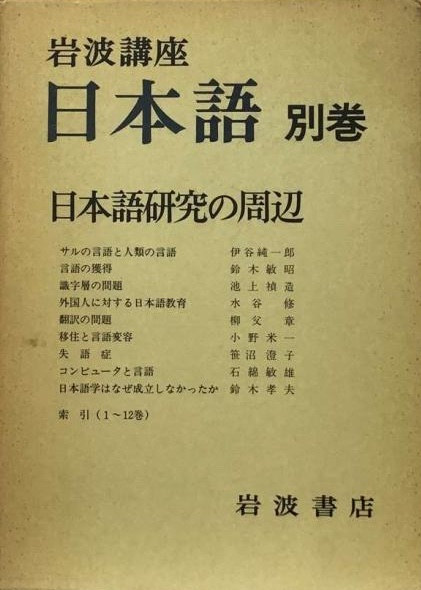
Proto-Japanese ( Wikipedia )
I don't know the author. When I looked it up on Wikipedia, I found that ``Arisaka = Ikegami's law'' was listed in the ``Japanese-Ryuu Proto-language'' section. Apparently, the theory is to find (determine) Old Japanese (proto-language) based on vowel harmony (a phenomenon in which there are certain restrictions on the combinations of vowels that appear in one word; a type of assimilation). is.
Exploring the ancestors of the Japanese language is very important not only for the Japanese language, but also for exploring the origins of Japanese culture. The discovery of Proto-Indo-European (ancestor of Indo-European languages) has clarified the basic characteristics of cultures from India to Europe. Of course, the cultures of India and Western Europe have changed significantly since they diverged. However, because they are the same, you can clearly see the difference.
There seem to be various theories as to where the Japanese word came from. Language and culture are transmitted. However, searching for its origins means that language ``generated'' somewhere and was passed down. This is similar to the theory that humans originated on the African continent and spread throughout the world. Is that so? Even if Proto-Indo-European had spread, were there no humans to whom it spread? Or were they “speechless”? I don't think so. I would like to think that, in the style of Kinji Imanishi, ``I spoke because I was meant to speak.'' We developed vocal cords, ears to hear voices, and the intelligence to understand them. Even if one member of a group (perhaps a child?) starts speaking as a ``mutation'', if there is no one to hear it, it cannot be called a language. I believe that a language must be established as a culture from the beginning, rather than just someone speaking it. The languages that began to be spoken in each region and by each group probably reflected the local climate. Even if the language spread or contracted afterwards, there is no doubt that it was influenced by the culture and customs of the region.
unused language or mother tongue
There are countless languages that are no longer in use. We cannot understand a language that is no longer in use unless it remains in written or written form. It is said that there may be languages that have been lost even at this very moment, and that there are thousands of other languages that are in the process of being lost.
Hebrew, the current official language of Israel, ceased to be a colloquial language approximately 1,800 years ago. The Old Testament was written in Hebrew. Although Hebrew continued to exist as a written language, it seems to have been revived as a colloquial language at the end of the 19th century.
Hebrew is the only language in history where an ancient language that once ceased to be used as a daily language has been revived and actually spoken again. (Wikipedia “ Hebrew ”)
As mentioned above, language is associated with climate and culture. It can only fulfill its role fully within the climate and culture. It's the same as a normal "tool". Ilyich clearly distinguishes between "vernacular spoken language" and "taught mother tongue."
As vernacular beings, people are born, grow up, and become men and women. Gender roles, on the other hand, are acquired. One can blame one's parents or society for one's assigned gender roles or the mother tongue one was taught, but there is nothing to complain about vernacular speech or gender.
The difference between vernacular gender and gender roles can be compared to the difference between vernacular spoken language and the mother tongue taught, and the difference between independence and self-sufficiency in life and economic-oriented life. (“Gender” Iwanami Gendai Sensho, P.171-172)
I believe that the Hebrew spoken in Israel falls under this "taught mother tongue." What about the Japanese we speak? I do not know. Dialects are being lost. And most of the words we speak are what we were taught in school, what we read in books, and what we hear broadcast on TV and radio. Regardless of whether you can write (read) or not, I think of it as your ``native language that you were taught.'' Furthermore, she is now learning English from elementary school. Japanese as a vernacular spoken language (Yamato language is basically a written language today) is influenced by the written language based on word-to-text correspondence, and is further influenced by the common language (standard language) by the mass media. , and is influenced by Indo-European languages such as English (even the English learned at school cannot be called a ``spoken language'').
Nevertheless, language has meaning within the climate and tangible and intangible culture. Therefore, like gender, it must continue to exist somewhere. I think we need to find that now.
literacy
My uncle couldn't read. Because of this, my uncle didn't have a driver's license. Even though his driving skills and knowledge were fine. My father, who was the youngest child, was loved by his uncle, so he seemed to take care of him in some way.
It is said that due to this school attendance rate, the illiteracy rate suddenly decreased in the 10 years before and after 1900. (Omitted) It goes without saying that it is too easy to estimate the illiteracy rate from the school enrollment rate, but since the Meiji era, society has moved and people's lives have been based on the assumption that everyone has the ability to read. I want to focus on that. (P.79)
Being ``illiterate'' is currently a huge hindrance in life. It has nothing to do with actual ability (technique). That is the premise of society. Text is also used extensively on television. Not only news headlines, but also variety shows often use decorative ``ticker'' characters. That caption makes me laugh. It's the same way that the old (and still present) audience's laughter makes you laugh. Even if you can't hear the voice, the characters, the speaker's intonation, and the pauses are funny.
When dealing with words, the relationship between spoken words and letters is not simple. I am acutely aware of the need for three-dimensional consideration of these issues, so I will list as many as I can think of and leave them as a side note. (P.86)
Speaking a language and writing are two completely different things. Reading without speaking aloud (silent reading) has been established in modern times (or rather, in modern times) in Western Europe. Reading was the act of speaking out what was written and making it sound like reality (it's a lie to read a letter by just staring at it in a historical drama). Silent reading separates letters from daily life (words) and makes them independent.
Is the increasing presence of text on television, such as in variety shows, a sign that vernacular spoken language and text are re-merging? I don't think so. Rather, it seems like the spoken word is being erased. The text is ``digitalization.'' Transcription (digitization) becomes possible by cutting out various things such as the climate and culture that surround spoken words, the situation in which they were spoken, the speaker's gestures, and the temperature at the time. Easy things are good, I don't want to experience pain or suffering. By living as data, things become easier, and if you input "feeling data" you will be happy (feel), which is truly a "painless civilization".
Whether this is true "happiness" is up to each person to judge. However, for this pain-free civilization to exist, don't we need a large number of people who feel pain? Another thing that transcribed (digitized) variety shows may teach us is that, while it still makes us laugh, vernacular spoken language has not disappeared yet. I wonder if we can find some missing pieces of gender there. At this point in time, I wanted to have some hope.