
この間、APDのことをツイッターでつぶやいたら「いいね」をもらっちゃいました。APDの研究・支援団体の人のようです。ちょっと微妙な気分です。
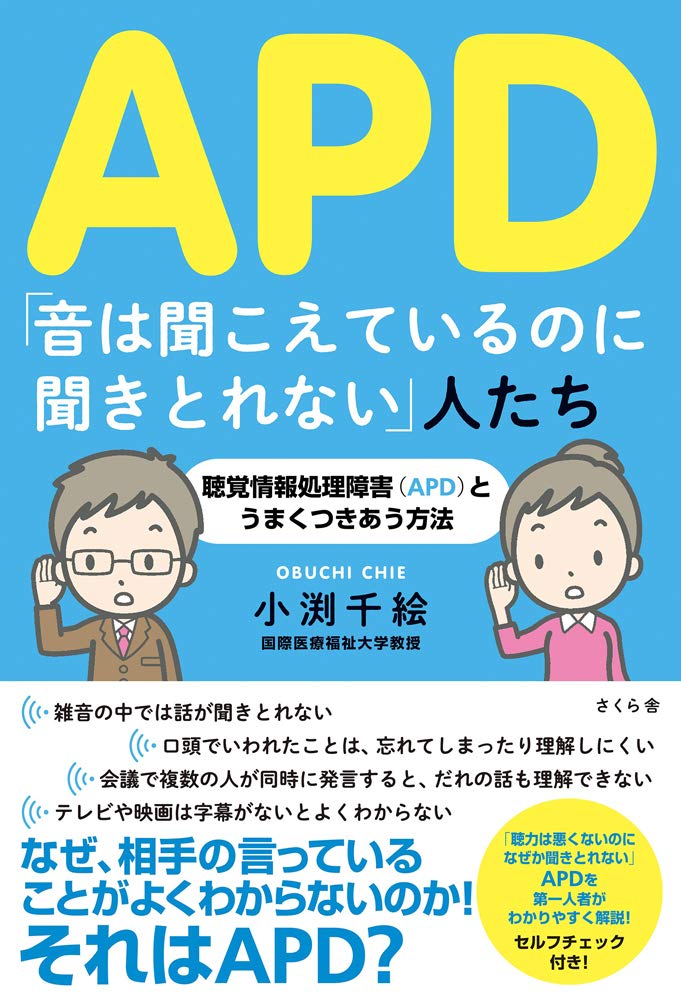
APDのことをわかってもらいたいという著者の気持ちがよく分かる本です。「わかってもらう」というのは、この病気(病状)そのものをもっと多くの人に知ってもらう、ということ。そのことでAPDの人が暮らしやすい世の中になります。
それと、知ってもらうことによってAPD「じゃない人」が心配して病院に押しかけることを防ぐということ。そして、APDの人にはちゃんと病院に行って検査・診断を受けてほしいということです。治療者にももっと理解してもらいたい、ということ。
人間の聴覚の仕組み(肉体的、物理的)、検査方法、対処方法が来院者の具体的な話を含めて簡潔にまとめられています。
ASDのこともちょっと書いてあります(発達障害ーASD、ADHD、LD等)。当初私は「聞き取れないなら、文字(パソコンとかスマホとか)を使えばいいじゃないか」と考えていましたが、そんなに簡単じゃないようですね。
「聞こえる」と「聞きとる」との違いは大きいです。そして「理解する」ということ。話し手の意図(この本の中にもこの言葉が出てきます)を汲み取ってそれに応じた発言をすることにはこの本の範囲を超えた広大な課題が存在します。
(1)病気はつくられる
いろいろな病名が発明されています。病気じゃない人がいないほどに(笑)。その基準は人間が決めたものです。逆に決められればそれは病気になります。そういう状況の原因は「健康神話(「健康帝国ナチス」)」にあります。日本では法律化されていますね。「健康増進法」です。「国民は…生涯にわたって…健康の増進に努めなければならない」だって。まさしく全体主義の法律ですよね。
みんな健康でなくちゃならないと思いこんでいます。「健康のためなら死んでもいい」と思うほどに(笑)。実際ジョギングで死んじゃう人がいますよね。健康が(自分のやりたいことをやるための)手段じゃなくて目的になっちゃってるんですね。
そのくせ、というか「それだから」なにか体調が悪いと、なにか「変」だと思ったら病院に行きます。そしてこの本にあるように「 何でもないですよ」とか「気のせいじゃないかな。精神的なものです」と言われると不安になります(医者はそれでは保険診療できないので、なにか病名をつけて「治療らしきもの」をしたりするのですが(^_^;)。精神科なんてまさにそうですよね。最後の砦ですから)。「病は気から」と言いますが、「気(感覚)は病から」生じるものですよね。まあ、人間は「頭で行動する(食事、セックス、排泄も)」ものだと言われていますから(実際は「人間」ではなくて「識字人」ですが)。だから、病名が付けられると安心します。病名付けられただけではなにも変わらないのですが。「原因がはっきりした」と思いこむわけです。原因は誰かが(医者たちが)「この基準でこういう病名にしよう」と決めただけです。だから、昔はなかった病名がどんどん増えます。APDも基準と病名がはっきりするでしょう。そして「治癒しない」となれば「障害認定」の基準にも取り入れられるかもしれません。「障害認定」は「認定」ですから、これも誰かが決めた基準に基づきます。
「原因」という「病気の実体(の存在)」というのは最近「発見」されたものです。それまでは病気は症状の総称でした。コッホが結核菌を発見したのが決定的です。病気の実体が発見されたのです。今の新型コロナウィルスも発見された実体です。病状ではありません。「感染者」という表現がありますが、感染は体内からウィルスが発見された場合に使うべきだと思います。唾液や鼻孔から検体を採ってPCR検査して、ウィルスが見つかっても口内や鼻孔は体の外部です。だいたい「陽性者」の多くは病状を持ちません。風邪はウィルス感染症ですが、病院に行ってもPCR検査はしないですよね。病状から「風邪(症候群)」という病名をつけるわけです。最も風邪の原因となるウィルスは数百種類あると言われていますから、PCR検査は無意味なことはおわかりいただけると思います。
APDには様々な原因があります。もちろん原因によって対処法が違ってくるのは当然です。でも、原因でAPDが「存在」すると病名(障害名)をつけるのがいいかどうかは一概には言えないと思っています。もちろん、患者(障害者)のことを一番に考えなければならないのは当然です。
(2)声は物理的なものか
聞こえる仕組み、音の要素、感覚器官と脳、などの説明があります。APDの実体を考えるには有効です。音は「音程(周波数)」「音圧」「音色」で表されます。人の話し声は「500〜4000Hz」というように。
「THEカラオケ☆バトル」という番組を見たことがありますか?カラオケを歌って「AI採点」するという番組です。この番組では歌っている間、画面の下に音程のグラフのようなものが出ます。合っていると黄色、外れると赤い棒になります。私は音痴なので、音程が合っているかどうか分かりません。だから、歌を聞くのじゃなくて、そのグラフが赤くなるかどうかドキドキしてみています(^_^;)。妻がいいました。「点数とうまいかどうかは違うよね。」そうです。「うまい」を数値化することはできないのです。この番組では、音程だけじゃなくて「シャクリ」「こぶし」などの加点要素があるようですが、なぜが100点以上は出ません(^_^;)。プロが自分の歌を歌っても「素人」より点数が低いです。というか、歌を音符というデジタル(つまり「楽譜」)にするということが不可能なのです。和音・ハモリを周波数で説明することは可能ですが、それは近似値を表しているにすぎません。私は音感がないので、平均律と古典調律の違いすら分かりません。楽譜ですべて表すことができるなら、誰が演奏しても同じ音楽になるはずです。指揮者は不要です(笑)。
私はテクノミュージックが好きです。テクノは「機械的だから嫌いだ」という人もいますが、テクノの歴史はいかに機械っぽくない音を作るかの歴史だったと思っています。YMOだってKraftwerkだって、最後の最後は人間が演奏します。だから「ライブ」が成立するのです。
「音程」「音圧」「音色」だけを解析しても、人間っぽい声にはなりません。どうしてもロボットの声(と言うとロボットに失礼ですが)になってしまいます。それで、最近はコンピュータで合成するにしても基には肉声が使われてい(ると思って)ます。
実は私は単音には「音程がない」と思っています。音程はその時に鳴っている他の音との関係、過去に鳴った音と現在の音と未来に鳴るであろう音とのつながり(流れ、運動)で発生するものだと思っているのです。そしてその音は声や楽器によって造られるのではなく、発音者(演奏者)と聞き手との相互作用で成り立つと思っています。そうだとすると科学的に解析できる音程と歌の巧さ(アート)とは同じことではないことになりますよね。
言葉は文字にはできません。でも、私たちは文字(音楽であれば楽譜)で考える(理解する)ことに慣れてしまっています。というか、文字が私たちを作っているのです。まるで食べ物が私たちを形作っているように。理解できないもの(見えないもの)を図やグラフや文字・記号(見えるもの)で「説明し理解した」と思いこむことに慣れてしまっています。食べることをやめられないのと同じように文字文化・識字文化(本だけでなく、テレビ、電話、インターネットなども文字文化です)から逃れることはできません(不可能ではありませんがとても困難です)。でも、このままでは「技術(テクノ)」が地球を破壊してしまいそうです。分離してしまったテクノとアートとの統合(アウフヘーベン)が求められています。
この本に書かれていることを否定する気はありません。「事実」なんだと思います。でも、APDの人がより良い生を送るために、原因を突き止めること、病気や障害と認定すること、治療法を発見すること、行政に働きかけることは必要ですが、根本的な解決にはなりません。APD以外にも「原因」や「治療法」がわからない病状はたくさんあります。それらに対応していけばいくほど社会は複雑になり、官僚制が進展します。そして常に「新しい弱者」が造られ続けると思うのです。原因や治療法が見つかったとしても、それを活かすためにも「社会のあり方(=思考法)」が変わらなければならないのではないでしょうか。
私がAPDのことをつぶやいたのは、そんな問題意識からです。だから「いいね」は微妙なのです。当事者にとっては原因や治療法、世間の認知度は重大な問題です。そのために著者には頑張ってもらいたいと思います(私に言われても迷惑かもしれません(^_^;))。私が考えていることはむしろ、なぜAPDのひとが生きにくいのかということです。それがわかればAPD以外の人も生きやすくなるのです。それは「多くの人に理解してもらう」ということではないと思います。一人の人間がすべての病気(事柄)を理解することはできないからです。医者にだって不可能なことはこの本に書いてあるとおりです。病気でなくても、世の中には色んな人がいます。10人いれば10の個性があるのです。APDも「個性」です。個性をなくして同質化しようという動きには断固反対します(「量産女子」の化粧や美容整形は嫌いです(^_^;))。それは全体主義ですから。そして、全体主義には異質なものの排除が「不可能な同質化」のために必要なのです。病名をつけることや障害認定をすることが安易に異質なものの排除につながることは想像できるのではないでしょうか。病名をつけたり障害認定をすることが不要な社会を作ることは時間がかかるかもしれません。地球環境が破壊される方が先かもしれません。でも、間に合わないかもしれないけど、それに向かって考え続けることしかないのではないのでしょうか。その歩みこそ希望だと思うのですが。
⟨impressions⟩
The other day, when I tweeted about APD on Twitter, I got a "Like". He seems to be a member of an APD research and support group. I feel a little delicate.
This book clearly shows the author's desire to understand APD. To "get it understood" means to let more people know about this disease (medical condition) itself. This will make it easier for APD people to live in the world.
Also, letting them know prevents APD "non-people" from worrying about rushing to the hospital. And I want people with APD to go to the hospital and have a test / diagnosis. I want the healer to understand more.
The mechanism of human hearing (physical and physical), examination methods, and coping methods are briefly summarized, including specific stories of visitors.
A little about ASD is also written (developmental disorders-ASD, ADHD, LD, etc.). At first, I thought, "If you can't hear it, you should use letters (computer, smartphone, etc.)", but it doesn't seem that easy.
There is a big difference between "hearing" and "listening". And "understand". There is a vast challenge beyond the scope of this book to capture the speaker's intentions (this word also appears in this book) and make corresponding statements.
(1) Illness is created
Various disease names have been invented. No one is sick (laughs). The standard is set by humans. On the contrary, if it is decided, it will get sick. The cause of such a situation lies in the "health myth (" health empire Nazis ")". It's legalized in Japan. It is a "health promotion method". "People ... have to work to improve their health ... for life." It's a totalitarian law, isn't it?
I think everyone has to be healthy. I thought, "You can die for your health" (laughs). In fact, some people die from jogging. Health has become a goal, not a means (to do what you want to do).
That habit, or "because of that", if I feel sick, I go to the hospital if I think something is "strange". And as in this book, I'm worried when people say, "It's nothing" or "I think it's because of my mind. It's mental." (Doctors can't provide medical insurance, so give them a name. I do something that seems to be a cure (^ _ ^;). That's exactly what psychiatry is, because it's the last fort). You say "disease comes from illness", but "ki (sense) comes from illness", doesn't it? Well, humans are said to "act with their heads (including eating, having sex, and excreting)" (although they are actually "literate people" rather than "humans"). Therefore, it is safe to give a disease name. Nothing changes just by naming the disease. I think that the cause is clear. The cause is that someone (doctors) just decided, "Let's name this disease by this standard." Therefore, the names of diseases that did not exist in the past are increasing steadily. APD will also have clear criteria and disease names. And if it does not heal, it may be incorporated into the criteria for "disability certification". Since "disability certification" is "certification", this is also based on a standard set by someone.
The "cause", the "entity of the disease", has recently been "discovered". Until then, illness was a general term for symptoms. It is decisive that Koch discovered the tubercle bacillus. The substance of the disease was discovered. The current new coronavirus is also the entity that was discovered. It is not a medical condition. There is an expression "infected person", but I think that infection should be used when a virus is found in the body. Even if a virus is found by taking a sample from saliva or nostrils and performing a PCR test, the mouth and nostrils are outside the body. Most "positive people" do not have a medical condition. A cold is a viral infection, but even if you go to the hospital, you don't do a PCR test. The name of the disease is "cold (syndrome)" based on the medical condition. It is said that there are hundreds of viruses that cause the most colds, so you can see that PCR tests are meaningless.
There are various causes for APD. Of course, the remedy depends on the cause. However, I don't think it can be said unconditionally whether it is better to give a disease name (disability name) when APD "exists" due to the cause. Of course, it is natural that the patient (disabled person) must be considered first.
(2) Is the voice physical?
There are explanations about how you hear, the elements of sound, the sensory organs and the brain, and so on. It is useful for thinking about the substance of APD. Sound is represented by "pitch (frequency)", "sound pressure", and "timbre". People's voice is like "500-4000Hz".
Have you ever seen a program called "THE Karaoke ☆ Battle"? It is a program that sings karaoke and "AI scores". In this program, while singing, something like a pitch graph appears at the bottom of the screen. If it matches, it becomes a yellow stick, and if it comes off, it becomes a red stick. I'm deaf, so I don't know if the pitch is right. So, instead of listening to the song, I'm thrilled to see if the graph turns red (^ _ ^;). My wife said. "It's different from the score, isn't it?" It is not possible to quantify "good". In this program, it seems that there are additional points such as "shakuri" and "fist" as well as the pitch, but why does not get more than 100 points (^ _ ^;). Even if a professional sings his own song, the score is lower than that of "amateur". In fact, it is impossible to make a song digital (that is, "score") called musical notes. It is possible to explain chords and harmonies in terms of frequency, but that is only an approximation. I have no sense of pitch, so I don't even know the difference between equal temperament and classical temperament. If you can express everything in the score, it should be the same music no matter who plays it. You don't need a conductor (laughs).
I like techno music. Some people say that techno is "mechanical, so I hate it", but I think the history of techno was the history of how to make sounds that are not mechanical. Whether it's YMO or Kraftwerk, humans play at the very end. That is why "live" is established.
Analyzing only "pitch", "sound pressure", and "timbre" does not produce a human-like voice. By all means, it becomes the voice of the robot (although it is rude to the robot). So, recently, even if it is synthesized by a computer, the real voice is used (I think) as the basis.
Actually, I think that a single note has "no pitch". I think that the pitch is generated by the relationship with other sounds that are sounding at that time, the connection (flow, movement) between the sound that was sounded in the past, the sound that is present, and the sound that will be sounded in the future. .. And I think that the sound is not made by voice or musical instrument, but by the interaction between the sounder (performer) and the listener. If so, the pitch that can be scientifically analyzed and the skill of the song (art) are not the same thing.
Words cannot be written. However, we are accustomed to thinking (understanding) with letters (musical scores in the case of music). Or rather, the letters make us. As if food is shaping us. I am accustomed to thinking that I "explained and understood" what I cannot understand (what I cannot see) with figures, graphs, letters and symbols (what I can see). Just as you can't stop eating, you can't escape from the culture of writing and literacy (not only books, but also TV, telephone, internet, etc.) (it's not impossible, but very difficult). However, if nothing is done, "technology (techno)" is likely to destroy the earth. There is a need for the integration of separated techno and art (Aufheben).
I have no intention of denying what is written in this book. I think it's a "fact". However, in order for APD people to live a better life, it is necessary to identify the cause, identify it as a disease or disorder, find a cure, and work with the government, but it will be a fundamental solution. not. In addition to APD, there are many medical conditions for which the "cause" and "cure" are unknown. The more we respond to them, the more complex the society becomes and the more the bureaucracy develops. And I think that "new weak people" will continue to be created. Even if a cause or cure is found, the "social way (= thinking method)" must change in order to make use of it.
I tweeted about APD because of that awareness of the problem. That's why "likes" are subtle. Causes, treatments, and public awareness are serious issues for the parties concerned. I would like the author to do his best for that (it may be annoying even if I tell you (^ _ ^;)). Rather, I'm wondering why people with APD are hard to live. Knowing that will make it easier for people other than APD to live. I don't think it means "getting a lot of people to understand." This is because one person cannot understand all illnesses (things). What even a doctor can't do is as described in this book. There are many people in the world, even if they are not ill. If there are 10 people, there are 10 personalities. APD is also "individuality". I strongly oppose the move to lose individuality and homogenize (I hate makeup and cosmetic surgery for "mass-produced girls" (^ _ ^;)). Because it is totalitarian. And totalitarianism is necessary for homogenization, which is impossible to eliminate foreign things. You can imagine that giving a disease name and recognizing a disability can easily lead to the elimination of foreign things. It may take time to create a society that does not require the name of the disease or the recognition of disability. The destruction of the global environment may come first. However, it may not be in time, but I think we have to keep thinking toward it. I think that only that step is hope.
The other day, when I tweeted about APD on Twitter, I got a "Like". He seems to be a member of an APD research and support group. I feel a little delicate.
This book clearly shows the author's desire to understand APD. To "get it understood" means to let more people know about this disease (medical condition) itself. This will make it easier for APD people to live in the world.
Also, letting them know prevents APD "non-people" from worrying about rushing to the hospital. And I want people with APD to go to the hospital and have a test / diagnosis. I want the healer to understand more.
The mechanism of human hearing (physical and physical), examination methods, and coping methods are briefly summarized, including specific stories of visitors.
A little about ASD is also written (developmental disorders-ASD, ADHD, LD, etc.). At first, I thought, "If you can't hear it, you should use letters (computer, smartphone, etc.)", but it doesn't seem that easy.
There is a big difference between "hearing" and "listening". And "understand". There is a vast challenge beyond the scope of this book to capture the speaker's intentions (this word also appears in this book) and make corresponding statements.
(1) Illness is created
Various disease names have been invented. No one is sick (laughs). The standard is set by humans. On the contrary, if it is decided, it will get sick. The cause of such a situation lies in the "health myth (" health empire Nazis ")". It's legalized in Japan. It is a "health promotion method". "People ... have to work to improve their health ... for life." It's a totalitarian law, isn't it?
I think everyone has to be healthy. I thought, "You can die for your health" (laughs). In fact, some people die from jogging. Health has become a goal, not a means (to do what you want to do).
That habit, or "because of that", if I feel sick, I go to the hospital if I think something is "strange". And as in this book, I'm worried when people say, "It's nothing" or "I think it's because of my mind. It's mental." (Doctors can't provide medical insurance, so give them a name. I do something that seems to be a cure (^ _ ^;). That's exactly what psychiatry is, because it's the last fort). You say "disease comes from illness", but "ki (sense) comes from illness", doesn't it? Well, humans are said to "act with their heads (including eating, having sex, and excreting)" (although they are actually "literate people" rather than "humans"). Therefore, it is safe to give a disease name. Nothing changes just by naming the disease. I think that the cause is clear. The cause is that someone (doctors) just decided, "Let's name this disease by this standard." Therefore, the names of diseases that did not exist in the past are increasing steadily. APD will also have clear criteria and disease names. And if it does not heal, it may be incorporated into the criteria for "disability certification". Since "disability certification" is "certification", this is also based on a standard set by someone.
The "cause", the "entity of the disease", has recently been "discovered". Until then, illness was a general term for symptoms. It is decisive that Koch discovered the tubercle bacillus. The substance of the disease was discovered. The current new coronavirus is also the entity that was discovered. It is not a medical condition. There is an expression "infected person", but I think that infection should be used when a virus is found in the body. Even if a virus is found by taking a sample from saliva or nostrils and performing a PCR test, the mouth and nostrils are outside the body. Most "positive people" do not have a medical condition. A cold is a viral infection, but even if you go to the hospital, you don't do a PCR test. The name of the disease is "cold (syndrome)" based on the medical condition. It is said that there are hundreds of viruses that cause the most colds, so you can see that PCR tests are meaningless.
There are various causes for APD. Of course, the remedy depends on the cause. However, I don't think it can be said unconditionally whether it is better to give a disease name (disability name) when APD "exists" due to the cause. Of course, it is natural that the patient (disabled person) must be considered first.
(2) Is the voice physical?
There are explanations about how you hear, the elements of sound, the sensory organs and the brain, and so on. It is useful for thinking about the substance of APD. Sound is represented by "pitch (frequency)", "sound pressure", and "timbre". People's voice is like "500-4000Hz".
Have you ever seen a program called "THE Karaoke ☆ Battle"? It is a program that sings karaoke and "AI scores". In this program, while singing, something like a pitch graph appears at the bottom of the screen. If it matches, it becomes a yellow stick, and if it comes off, it becomes a red stick. I'm deaf, so I don't know if the pitch is right. So, instead of listening to the song, I'm thrilled to see if the graph turns red (^ _ ^;). My wife said. "It's different from the score, isn't it?" It is not possible to quantify "good". In this program, it seems that there are additional points such as "shakuri" and "fist" as well as the pitch, but why does not get more than 100 points (^ _ ^;). Even if a professional sings his own song, the score is lower than that of "amateur". In fact, it is impossible to make a song digital (that is, "score") called musical notes. It is possible to explain chords and harmonies in terms of frequency, but that is only an approximation. I have no sense of pitch, so I don't even know the difference between equal temperament and classical temperament. If you can express everything in the score, it should be the same music no matter who plays it. You don't need a conductor (laughs).
I like techno music. Some people say that techno is "mechanical, so I hate it", but I think the history of techno was the history of how to make sounds that are not mechanical. Whether it's YMO or Kraftwerk, humans play at the very end. That is why "live" is established.
Analyzing only "pitch", "sound pressure", and "timbre" does not produce a human-like voice. By all means, it becomes the voice of the robot (although it is rude to the robot). So, recently, even if it is synthesized by a computer, the real voice is used (I think) as the basis.
Actually, I think that a single note has "no pitch". I think that the pitch is generated by the relationship with other sounds that are sounding at that time, the connection (flow, movement) between the sound that was sounded in the past, the sound that is present, and the sound that will be sounded in the future. .. And I think that the sound is not made by voice or musical instrument, but by the interaction between the sounder (performer) and the listener. If so, the pitch that can be scientifically analyzed and the skill of the song (art) are not the same thing.
Words cannot be written. However, we are accustomed to thinking (understanding) with letters (musical scores in the case of music). Or rather, the letters make us. As if food is shaping us. I am accustomed to thinking that I "explained and understood" what I cannot understand (what I cannot see) with figures, graphs, letters and symbols (what I can see). Just as you can't stop eating, you can't escape from the culture of writing and literacy (not only books, but also TV, telephone, internet, etc.) (it's not impossible, but very difficult). However, if nothing is done, "technology (techno)" is likely to destroy the earth. There is a need for the integration of separated techno and art (Aufheben).
I have no intention of denying what is written in this book. I think it's a "fact". However, in order for APD people to live a better life, it is necessary to identify the cause, identify it as a disease or disorder, find a cure, and work with the government, but it will be a fundamental solution. not. In addition to APD, there are many medical conditions for which the "cause" and "cure" are unknown. The more we respond to them, the more complex the society becomes and the more the bureaucracy develops. And I think that "new weak people" will continue to be created. Even if a cause or cure is found, the "social way (= thinking method)" must change in order to make use of it.
I tweeted about APD because of that awareness of the problem. That's why "likes" are subtle. Causes, treatments, and public awareness are serious issues for the parties concerned. I would like the author to do his best for that (it may be annoying even if I tell you (^ _ ^;)). Rather, I'm wondering why people with APD are hard to live. Knowing that will make it easier for people other than APD to live. I don't think it means "getting a lot of people to understand." This is because one person cannot understand all illnesses (things). What even a doctor can't do is as described in this book. There are many people in the world, even if they are not ill. If there are 10 people, there are 10 personalities. APD is also "individuality". I strongly oppose the move to lose individuality and homogenize (I hate makeup and cosmetic surgery for "mass-produced girls" (^ _ ^;)). Because it is totalitarian. And totalitarianism is necessary for homogenization, which is impossible to eliminate foreign things. You can imagine that giving a disease name and recognizing a disability can easily lead to the elimination of foreign things. It may take time to create a society that does not require the name of the disease or the recognition of disability. The destruction of the global environment may come first. However, it may not be in time, but I think we have to keep thinking toward it. I think that only that step is hope.
[出演者(プロフィール)]
小渕 千絵(おぶち・ちえ)
1974年、東京に生まれる。立教大学文学部心理学科卒業、東京学芸大学大学院教育学研究科、筑波大学大学院心身障害学研究科修了、博士(心身障害学)取得。川口市立医療センターリハビリテーション科、埼玉医科大学病院小児科などで言語聴覚士として勤務ののち、国際医療福祉大学保健医療学部言語聴覚学科准教授を経て、2020年、同大学成田保健医療学部言語聴覚学科教授。あわせて国際医療福祉大学クリニック言語聴覚センターなどで聞こえにくさの相談・指導などを担当している。
APD(聴覚情報処理障害)の研究に20年以上にわたり取り組む第一人者である。
「雑音の中では話が聞きとれない」「口頭の指示は忘れてしまったり理解しにくい」
「話を聞きながらメモやノートをとるのが苦手」「話が長くなると、途中から何を
いっているのかわからなくなる」――このように「音は聞こえているのに聞きとれない」
という症状を「APD(聴覚情報処理障害)」といい、いま注目されている。
APDの原因は次の4つのタイプ(1脳損傷の既往のあるタイプ、2発達障害タイプ、
3認知的な偏りのあるタイプ、4心理的な問題を抱えるタイプ)に分かれることが
わかってきた。聞きとれずにミスをしたり人間関係がこじれたりなどトラブルを抱えると
「自分はダメな人間だ」と責めがちだが、発達障害や脳の認知機能の問題が関係して
いるのだから、本人のせいではない。APDを生まれながらの特性や個性のひとつとして
とらえ、うまくつきあう方法を考えることが大切だ。まずはAPDについて知り、正しく
理解することが重要である。
「聞こえ」のわかりやすい解説とAPD症状例、対処方法などを盛り込んだ、APD
第一人者による決定版! オリジナルのAPDセルフチェックシート付き!
「聞こえているのに聞きとれない」APD(聴覚情報処理障害)とは?大人のAPDは4タイプ((1)脳損傷タイプ、(2)発達障害タイプ、(3)認知的な偏りタイプ、(4)心理的な問題タイプ)に分けられます。それぞれの要因や状況によって、改善策や対処法も異なってくることがわかってきました。「聞きとり困難」を自分の特性や個性と考えて、うまくつきあう方法を考えることが大切です。
「話を聞きながらメモやノートをとるのが苦手」「話が長くなると、途中から何を
いっているのかわからなくなる」――このように「音は聞こえているのに聞きとれない」
という症状を「APD(聴覚情報処理障害)」といい、いま注目されている。
APDの原因は次の4つのタイプ(1脳損傷の既往のあるタイプ、2発達障害タイプ、
3認知的な偏りのあるタイプ、4心理的な問題を抱えるタイプ)に分かれることが
わかってきた。聞きとれずにミスをしたり人間関係がこじれたりなどトラブルを抱えると
「自分はダメな人間だ」と責めがちだが、発達障害や脳の認知機能の問題が関係して
いるのだから、本人のせいではない。APDを生まれながらの特性や個性のひとつとして
とらえ、うまくつきあう方法を考えることが大切だ。まずはAPDについて知り、正しく
理解することが重要である。
「聞こえ」のわかりやすい解説とAPD症状例、対処方法などを盛り込んだ、APD
第一人者による決定版! オリジナルのAPDセルフチェックシート付き!
「聞こえているのに聞きとれない」APD(聴覚情報処理障害)とは?大人のAPDは4タイプ((1)脳損傷タイプ、(2)発達障害タイプ、(3)認知的な偏りタイプ、(4)心理的な問題タイプ)に分けられます。それぞれの要因や状況によって、改善策や対処法も異なってくることがわかってきました。「聞きとり困難」を自分の特性や個性と考えて、うまくつきあう方法を考えることが大切です。
[拡大] [ ISBN-13 : 978-4865812497 ]

