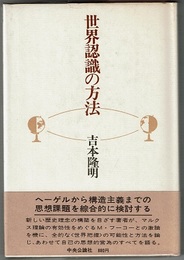
Takaaki Yoshimoto vs Michel Foucault
This is a used book. Maybe 100 yen. It was published in 1980, so over 40 years ago (before the consumption tax started, of course).
The beginning is a dialogue between a Western European master and a Japanese master (others are interviews at the time). When I read it (last year?), I thought the two didn't get along, but when I read it again, it turned out to be a pretty good dialogue. There may have been translation problems.
The author's thoughts will continue after this, but I haven't read it, so for the time being, I'm limited to the contents of this book.
It is the time between the publication of the first volume of Foucault's History of Sex and the publication of the second and third volumes. For Foucault at the time (even before that), power and truth were at the center of his thinking. At that point, I think that the confrontation with Marx was no longer central to Foucault. I think that the author still had to confront Marx, and the sense of distance created the impression of "disengagement".
In the West, Marx is a consequence of Western philosophy, and it is positioned in the history of the West, or in the history of philosophy. Confronting Marx is like confronting Aristotle or Nietzsche. However, Marx, or Marxism in Japan, is a "foreign thought" that cannot be positioned within the flow of Japanese thought history. Isn't it different from facing off against Shinran and Sorai Ogyu?
(Foucault) In other words, Marxism is the totality of power relations, or the totality of power mechanics and power dynamics. (P.16)
(Foucault) because it has emerged as a science, a science, in a rational or rational way of thinking. The question of what kind of dynamics of power relations a so-called rational society like Western society entrusts to science does not come down to the fact that science functions simply as a collection of propositions that can be regarded as truths. At the same time, it is deeply related to a series of binding propositions. In other words, Marxism, as far as science is concerned, is a science of history, a science of human history, and a dynamic that has a binding effect on certain truths. It is also a prophetic science that spreads the binding power of a certain truth to the future of the world. In other words, it is important that science and prophecy function as a binding force over truth. (P.16-17)
This is Foucault's evaluation of Marx. On the other hand, the author criticizes "Marxism" and seems to be trying to scoop up "Marx" from Marxism. Scholars have rummaged through Marx's writings on how the Communist Party, the Socialist Association, or the socialism of the Soviet Union and China differ from Marx's words, and are vying to claim that these are the true words of Marx. I was. I also say, "It is Engels' idea that is said to be Marxism (Leninism)," "The Communist Party misinterprets it," and "This is what Marx really wanted (Marx of truth, Marx The truth of the world)” and so on. That's how I used Marx to justify my thoughts. I picked up Marx's words and tried to explain them. But among them, there were things I couldn't explain, things I couldn't convince the people of, and things I couldn't convince myself in the first place. The author summarizes (post-war) Marxism in Japan.
(Yoshimoto) Japan's post-war Marxism, in terms of subjectivity materialism, was developed in Russia based on Hegel's holistic framework, which Marx did not abandon. I have taken the problem awareness of trying to revive it by screwing it into Marxist materialism. It seems to me that this is perhaps the opposite of the French Marxist way of doing things. Japanese Subjectivity Marxism has attempted to revive everything within Marxism, including Hegel's realm of state philosophy, religious theory, individual morality, and self-consciousness. Based on this trend, Hegel's system is summarized as a theory of will. (P.32)
(Yoshimoto) I believe that the concept of civil society is based on Marx's alienation = expression'' of nature'' philosophy, so what is a Marxist''? It may be as if it were wrong. (Not a dialogue, but an interview. P.128)
To that, Foucault replied,
(Foucault) In the end, what is right? It's a point of view that is caught in the power of truth and its effects, so to speak, what is wrong and what is wrong. In other words, our thinking is impoverished by the point of view of whether or not to connect what is the correct and true Marx, or the effect of the truth, with this national philosophy of Marxism. is. (P.19)
In other words, it doesn't matter (?) whether it's "correct or incorrect" or "truth". Rather, it asks what is 'truth' or 'right' and how it relates to 'power', or rather how power operates through 'truth'.
Structure
The scheme of "capitalists vs. workers" was also broken among scholars. It was said that there were no rulers (classes) or capitalists. I felt that it was "the ruler's (class)'s choice." So why are the workers (class) (me) having such a hard time? Hierarchy has been replaced by structure. Some people call Foucault a "structuralist," but I don't think so.
I understand that it is a structure called capitalism, not capitalists. Even if the founder dies, the company survives. Even if the ruling political party and the prime minister change, the nation called Japan and Japanese capitalism will continue. The “gears” of each of us can be replaced. As the "structure" replaces the "person", the "I" becomes weaker and weaker. It seems possible to avoid responsibility by saying, "It's not my fault. It's the structure."
I don't know what you mean by "structure". It's one of the lesser-known words, like "organic". If you look it up in a dictionary, you'll understand, but academic terms in Western Europe are mostly everyday words, unlike in Japan. So it has a unique meaning within the culture and linguistic structure. Just as "michi" in Japanese does not only mean "road", organ is also a musical instrument organ, a living tissue, and a carbon-containing substance. My impression is that various things are intricately intertwined and gathered together.
"Structure" means "something that is not immediately visible" or "something that supports the visible part with shadows". In contrast to organic matter, which focuses on things that are gathered together, structure seems to focus on the relationships between them. A building is also a structure, but first of all it is not a "living thing". And what makes a building a building is the "structure". Therefore, what makes a block of wood work as a desk is the idea of wood''. It feels very platonic. Is organic aristotelian in comparison?
Structural anthropology focuses not on the visible parts of society (culture), but on the kinship relationships that make up society (culture) behind the scenes. Structural linguistics focuses on the structures that make up each language (or words) rather than on each language. The structure of a language is just the grammar. I think that when we think about the fundamentals that make up a "language" rather than specific languages, we will come up with a "universal grammar" and a "generative grammar" as the ability to use language. increase.
The basis of Western scholarship is to be analytical. For example, language is divided into sentences, words, and even phonemes (segmentation, classification). Then, we can consider the relationship between the elements. This is sogo (unification). At its core is the idea that the whole is a collection of parts. When you understand the parts (individuals, specials) and their relationships, you have "understood" or "found the truth" of something. This is "Western knowledge".
Western knowledge has come and gone, depending on whether the focus is on the individual or the whole. Focusing on the whole results in totalitarianism. I believe that Gestalt psychology focuses on the whole.
Furthermore, what modern scholarship has overlooked is what it means to "make something" an object of contemplation in the first place, and how to do it. Is it possible? To say that there is something that becomes an object means that there is a "subject" that makes (or places) it as an object. The existence of the subject (ego) is the tacit premise of modern Western knowledge.
Basically, don't ask that. This is because "objective truth" is established by shelving it. Wissenschaft is Western knowledge and learning (Science, Wissenschaft) that can exist without the involvement of the subject (whether it is an individual thing or a whole). It is about questioning itself. says Foucault.
(Foucault) We need to let all experiences speak, and listen to the mute, the excluded, the dying. For we are on the outside, and it is they who are effectively dealing with the dark and isolated aspects of the struggle. And I believe that listening to such words is the duty of philosophers living in the West today. (P.44)
Foucault listens to and considers objects (whether workers, states, or “structures”). In other words, in order to be a philosopher, I had to stand 'outside'. The eyes that stand outside and look at existence (existence) are "God's eyes". Foucault was aware of this, I think he was aware of it. It's not that Foucault is God. He is aware that he can only speak from the outside.
Existence (On τὸ ἐόν, esse, Sein)
To talk about the unspeakable, says Mr. Yoshimoto.
(Yoshimoto) It was noticed after the emergence of phenomenological ideas. Husserl and Heidegger themselves, as well as Sartre and Merleau-Ponty, who were influenced by them, did not have to be conscious of it, and in fact, the problem of error was created if they were not really conscious of it. I think that's what happened. It has to do with the carry-over of self-consciousness that, in modern times, human beings have become separated from reality like a membrane.
It is a problem of consciousness that there is a rift between action and practice and concrete reality itself in the real world depicted as an idea, and that human beings work on reality. It means that the concreteness of the work is different from the fact. (P.137-138)
(Yoshimoto) Phenomenology has discovered that the object'' itself and the object'' that humans see as objects are completely different things. . (P.139)
These "films" and "cracks" are nothing that phenomenology has noticed. Parmenides knew, and the Pythagoreans kept it a secret. Heidegger said that what we should consider is not existence (Sein, existence itself)'' but existing things/beings, Seiende''. And what makes that being a being, that is, a human being, is called Existence Da-sein''. This is the object and the subject that considers it. Between the subject and the object there is an "insurmountable crack" or "film". It is the groove between "I and you" ("Between a man and a woman there is a deep and dark river" by Akiyuki Nosaka, Kuro no Funauta). This gap is created by the self, the subject, but Western knowledge has become eager to overcome the gap and to know the object ("Row and Row, don't look back Row ”) Modern Western knowledge (science and philosophy) “pretends to forget” the essential “existence itself” (I have never read Husserl, Heidegger, or Merleau-Ponty).
When you have consciousness (subjectivity, ego), the existence as an object becomes an "existent" regardless of the viewpoint. No matter how much science develops, no matter how many different perspectives we take, or whether we take the perspective of the infinite God,'' we cannot perceive existing things'' or self/existence'' as existence itself''. It is impossible. Existence is "that which cannot be spoken."
Will
(Foucault) Western philosophy has indeed talked about consciousness, and about desires and passions. I think that was the greatest weakness of Western philosophy. (Omitted) Either the will-nature-force or the will-law-good and evil, Western philosophical thinking about the will has been reduced to these two schemes. (P.23)
I have a habit of considering everything as an object. I was taught that it was "logical" and "correct", and I believed it. In my daily life, and of course in my work, I've been saying, "That's right." More so for those who are called scholars. It can be said that such things are people at work.
Taking the things around you as objects is the will to be the subject. Being a subject is itself a will. Growing up in a post-war democratic education, I was told to "be yourself" and "have your own will." But the more you have yourself, the more distant you are from others. Targeting means keeping it as far away from you as possible (if it's too close, you won't see it). It is "objective" to not include yourself as much as possible. However, if we target not only objects and others but also ourselves, we cannot logically explain even our own thoughts and bodies.
The isolated self is attracted to things that cannot be explained logically, such as the deep unconscious and madness. I think that's what Freud thought of the "unconscious" as "being". It is not "conscious", so there is no way to think with consciousness. But it is not "nonexistent" or "supernatural". Even a ghost becomes "existence (person)" when it becomes conscious (recognised) of it. It is "not not" (Parmenides). The unconscious is not like that. I think it's "existence itself". Without fear of misunderstanding, it is "nature itself". Unconsciousness, madness, and for me sex are also things that "exist." However, as soon as we consider them as subjects (ego), they change from beings to beings. And at the same time that they become existences, they are distant'' to me and confront (hostile)'' me.
I am an outsider now. As an old hikikomori, I am no longer part of the proletariat, and thinking of the proletariat as an object means that I am already outside. As I saw myself as an object, I was already outside while I was inside the proletariat. It seems to me that the various contradictions that the labor movement brought to me were precisely in its objectification. The sense of incompatibility with "should", in other words, the contradiction between logic and ethics, was brought about by this objectification. And that is unacceptable as such.
States
(Foucault) States were always founded on religion. Therefore, there could be no such thing as a philosophical state. (omitted) To summarize, these three aspects of Marxism—Marxism as a scientific discourse, Marxism as prophecy, and Marxism as a state philosophy or class ideology—are closely related to the totality of power relations. I can't help but have (P.18)
There is a difference between religion (God) in a culture centered on the subject (subject, ego) and religion in a culture centered on existence itself (nature). The latter is called animism (pantheism), but Japanese people are familiar with it. For a culture that places the subject at the center, it becomes very difficult to relate to nature and other people that have become objectified. God is what connects me with the outside world and others. Nature, others, and myself, who were originally existence itself'', are equal before God'', and God is something that cannot be considered,'' things that must not be thought,'' and things that believe.'' . God is "alienated existence itself."
When God died (Nietzsche), it was replaced by 'human', 'subjectivity' and 'science'. Science is reason and logic. Politics based on reason rather than religion (state management). The idea that nature, society, and the state can be controlled (ruled) by reason (science) is an inevitable result of subjective culture. The “planned economy” is exactly the result.
Many of the so-called developed countries said that "planned economies have failed." “Socialism has failed,” he said. Is that true? Countries called developed countries are countries of culture dominated by "science" or "reason". People think that nature (mountains, rivers, animals, plants, etc.) can be controlled by reason, but why is it that nations and societies cannot be controlled? This is probably because they believe that nations and societies have human beings, that is, "subjective will."
(Yoshimoto) The government is, so to speak, the body of the national will, not the national will itself. I think that the national will and the state institutions must be considered separately. Should I call it class struggle supremacy, or do I choose any means for the purpose, so-called moral issues, issues of good and evil, issues of religion, all such things are ignored, even if they are not ignored, they have a subordinate meaning. I think that the reason why I have come to the point where there are only meanings of , second and third meanings is that I immediately equated the will of the state with the institutions of the state, and directly linked it to class oppression. I think (P.45-46)
The socialist state is probably the result of this hypertrophied subjectivity suppressing ethics and religion and taking reason (science) as absolute.
History
(Yoshimoto) In other words, there are various ways of thinking such as existence and subject, but the idea that the concept of history cannot exist without it is It seems to be at the root of the position of history. In addition, the concept of time is inevitably included in the concept of history. Even if how we deal with time is individual, the concept of time inevitably follows the concept of history. In that case, the concept of structure tries to incorporate the concept of chance series or, in Foucault's terms, the concept of discontinuity into the concept of history. This can be called discontinuous serialization or discontinuous systematization. (P.55-56)
(Yoshimoto) In the Hegel-Marx line of thinking, the concept of human beings is attached to the concept of human beings. is synonymous with thinking about humans. Foucault goes on to say that the concept of the human being has only been around since the second century. This sounds like a very nice fresh start. As I said in the dialogue, in order for such a way of thinking to be viable, I think we must abandon the concept of the world. After all, I think that it is the compensation for abandoning the concept of comprehensiveness of world recognition. I think that abandoning the holistic view of the world includes the view that the concept of the totality of the world is no longer worthy of consideration. It did not originate with Foucault, but Nietzsche, who was the first classicist and historian to object to Hegel, was of the same age. Since it does not hold, he states that concrete history does not transition in a way that is accidental, inevitable, or a stage in history, but that he only thinks of it in terms of symbolic concepts. (P.63-64)
"History" (ἱστορίαι, Latin transcription: historiai) written by Herodotus means "investigation and inquiry." And he wrote down what he knew and what he knew. History is "written history". History can only be found in "cultures where written history remains" (history).
The culture of subjectivity inevitably objectifies subjectivity. Objectification begins with voicing. But the best thing is to externalize it, to make it visible. Fixing subjectivity, fixing voice, that is, letters. Concerning letters, Socrates says
In fact, Phaedrus, there are, I think, the following difficulties in writing, and the circumstances are as true as in painting. They look very similar. That is to say, when you look at the creation of a painting, it stands as if it were alive, but when you ask it something, it is arrogant and silent and does not answer. The written word is the same. . . . And any word, once written down, wanders from one place to another, whether to those who understand it or to those who are utterly unfit. . And it is not possible to speak only to those who must be spoken to and remain silent to those who are not. ("Phaedrus" Plato Vol. 5, p.257)
It says. So why did Plato write a book against the words of his master?
(Yoshimoto) The internality that imposes on communality is called , must accept. There, the internal "communal illusion" is out of phase with this illusion and is in a "handstand" relationship. Then he exchanges what he should participate in with the act of the mind and ideas for the trouble that he can only participate with the body.
The notion of the practice of political and social movements is in the realm of Negativity and does not constitute History per se. Both what constitutes 'History' and what embodies 'History' are in the illusionary realm of the idea of 'denial of negativity'. (P.146-147)
(Yoshimoto) I think that the driving force behind the conversion and development of family'' communalities into relatives'' communalities and clan'' communalities is all about the anti-fantasy''. > area. However, for this development, I think we have to assume the dual coexistence of affinity and prohibition.
In that case, is the natural basis of , and at the same time, 's state is . vinegar. In order for to develop into , the concept of prohibition must first be introduced to the same generation within the family. (P.150)
The key to understanding Takaaki Yoshimoto is . It can be simply understood as "relationship" or "structure". Or you might say that it is a gestalt that includes them. In one aspect, it is an attempt to express “existence itself”. It is not "fantasy" or "supernatural". Married couples, parents and children, villages, and societies exist and have certain "relationships." However, as soon as it becomes "existing things" and "beings", its existence disappears.
It is modern times that Foucault is forced to be sexual. If we trace it all the way back to classical Greece, even if we discover something that leads to modern Western Europe, it is still "Western Europe." So he discovered "self-care" and "utilization of pleasure." It was the Romans (Christianity) who rediscovered it as "ego" by Plato, and the modern age (Descartes) who rediscovered it by Aristotle. Just as ego'' and self'' were Japanese around the Meiji era, until then Japan had watashi'' but no ego'' or individual'' (so there was no society'' in Western Europe). ). What the "ego" found in the "self" is appetite and libido. It may correspond to "self" and "other". I had to deal with it. For the self, not only others but also one's own body is an object, and it appears as "something estranged" and "something that does not belong to me." I couldn't deny it. If we could, the West would not exist today.
(Yoshimoto) However, for humans, has a duality of being both a natural animal behavior and a fantastical behavior. (P.150)
It is not for humans'', but for Western Europe'' or for subjectivity''. When we look at illusions from the perspective of subjectivity, we see a "double system." They are "Existence" and "Existence/Existence". But I can no longer confirm that with Mr. Yoshimoto.
Perceptions of the World
People are responsible for what others have made them. Because even if it is a virtual image, it is a place where the truth resides. And in this case it doesn't matter if it's a virtual image or not, what matters is where the truth resides.
I have endured the changes in the world'' during this period as a question of how to grasp the ``world'' in the dialogue contained in this book. To put it a little more accurately, is it possible to perceive the "world"? (Afterword, P.192)
I am the product of my culture (including my language, of course). I have thought about society more than my parents who gave birth to me. Far from being grateful to my parents, I thought, "I was born in this world."
Now that I am almost out of society, I realized that my consciousness and preconceptions (virtual images) are “created”. If you exclude it from the ego in me, the ego disappears. At this age, I'm going to deny all the life itself until now. But it has to be closed somewhere.
My ego doesn't seem to go away. I have a hunch that without it, we will not be able to recognize the "world" as "existence itself." I also think that it is useless while I am writing letters like this. This is because the “ego” wants to give form to what you are thinking, and to leave it behind.
Now I am outside of the culture. I don't know how much time is left, but to continue denying myself, to rescue "existence itself" in what I have denied until now, that is the "world perception" for me outside. I think it's a "method".