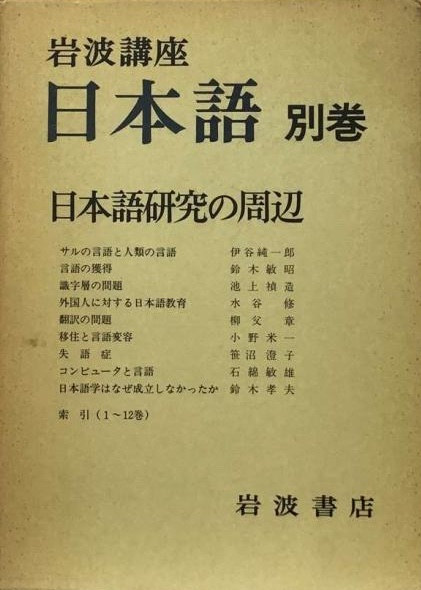
Not a "night watch teacher"
I don't know about the author. If you look at Wikipedia, you'll find "Yomawari Sensei" who has the same last name, but even if you look at his date of birth, he's a different person (though I don't even know "Yomawari Sensei").
This is a paper from the standpoint of teaching Japanese. When I think of Japanese language teachers, I think of Takehiro Kanaya ("Japanese doesn't need a subject," " Japanese never dies ," " Japanese has honorifics but no subjects, " etc.), but when you're in the position of teaching, , I seem to be able to see something different from what so-called linguists see. I think it's the difference between what you think in your head and what you experience. There is almost no discussion of Japanese grammar in this paper. But I felt like we had a similar understanding.
English in Japan
The passion and energy that Japanese people have poured into English education is enormous. After the Meiji era, Japan's national challenge was how to absorb Western culture and technology, so it's easy to see how much energy was spent on this, and it's still true today. The fact that the majority of the Koreans have been studying English for a long period of time means that, even taking into account the fact that English qualifies as an international language, as a country that was not a colony, it is one of the world's leading languages. But it's probably a rare case. The depth of interest that Japanese people have in English education as a whole is surprising, especially despite the fact that most people have very few opportunities to actually use English. (P.95)
You taught English at junior high school and high school for six years, and now it seems like you're teaching English at elementary school as well. If you study one foreign language for six years, you should be able to read and speak it to some extent, but the reason there aren't many people like that is because they don't have the opportunity to use English. I don't think many people learn English as a means of being useful. For example, maybe you want to go to America and study theater, or you need to read English books for some specialized research. What you simply memorized by staying overnight for a test will be forgotten as soon as the test is over. It's very painful to learn something you won't use before. The same goes for mathematics and physics. School education may just teach us how to "endure" such things.
Those who persevere will get good marks and be praised by their teachers and parents. Not only that, but they also tend to look down on those who don't score well. I like quiz shows. You can feel satisfied by showing off your knowledge. I especially like ``Kaikai Sensei Tanaka,'' in which Ano-chan appears, but I find myself making fun of celebrities who give stupid answers.
If you see a foreigner, you think it's American, and if it's not Japanese, you think it's English, which causes a strange reaction among foreigners who are learning Japanese.
It's not just that they have less interest in languages other than English. He seems to have no confidence even in the Japanese language itself, and when talking to British or American people, no matter how good the other person's Japanese is, or even if they have the intention of speaking in Japanese, he interrupts them and tries to speak English. There is a tendency to try to use it, which can lead to questions from Japanese learners. (P.100)
This is also what I experienced. Most foreigners who work or do business in Japan know the Japanese necessary for their job, but have you ever spoken to someone in English? It's embarrassing to think about it now, but those are the only times I get a chance to use the English I worked so hard to learn.
Language education in history
As past history has shown, language education has often been dominated by political and economic objectives. Japanese language education for Japan's colonial rule - the fact that it became a part of the education for Japanese nationalization on the continent and the south, and the language policies implemented by Britain and France in their colonies were also caused by powerful ethnic groups It was nothing more than a control measure.
However, just as language itself has the ability to change people's way of thinking, the use of foreign languages also has the potential to reduce international friction, if used in the right way. No, rather, this possibility exists only in the practical communication of language, and we must pursue foreign language education and the appropriateness of its use based on the great goal of human happiness. Probably not. (P.101)
I wrote something like this before.
In ``Black Skin, White Masks,'' Frantz Fanon depicts the attitude of white people when talking to black people. He chooses easy words and speaks slowly. Then, when the black person replies in correct French, they are surprised and try to deny it. The same thing happens when Japanese people talk to foreigners (blonde, white-skinned people, dark-skinned people, people who are obviously foreigners). Speak slowly and choose simple Japanese words. When the other person replies in fluent Japanese, they say, ``You sound Japanese.'' The same thing applies when we talk to children and the elderly. If you speak to them slowly and in simple words, and a child or elderly person responds in the same way as a young person, don't they get surprised and say, ``That's not like a child'' or ``That's not an old man,'' or deny it? (My manuscript “ Reviews on the meaning of aging ”)
In some of the overseas countries I've been to, no one speaks Japanese (aside from vendors and guides at tourist spots). I don't think I've ever been spoken to in Japanese (although I was once mistaken for a Chinese person). It is said that French people value French, but English was not spoken even in department stores. You may understand it because it's simple English, but the attitude is, ``If you're in France, speak French.''
Japan has certainly succeeded in absorbing culture and technology from countries considered to be developed countries through English. What I learned through English plays a large role not only in my lifestyle but also in my way of thinking. (P.96)
Half a century has passed since this book was published. During that time, I think the status of English as an international language has increased. However, I don't think that being able to speak English (or Japanese) for many people has the potential to reduce international friction. Certainly, if foreigners study Japanese, it will help them understand Japan. I'll write more about this in my next review of ``Problems with Translation'' (by Akira Yanagi), but Japan has a long history of interpreting Chinese (Kanbun) rather than English. And it is certain that Chinese literature and Buddhism, which came through Chinese literature, have had a great influence on Japanese spirituality. However, I don't think that the ideas of Confucius and Laozi were directly introduced into Japan, and I don't think that Buddhism was directly adopted from India. It was a ``Japanese interpretation,'' and I think that kind of interpretation is still widely used today. Isn't this the case with classical Greek philosophy, Christianity, and modern philosophy?
Japanese things
However, he himself does not know which of these is ``Japanese.'' Those who understand that this is Japanese may not be academics, but rather people who have taught Japanese, like the author. I'll give you one example that I didn't know about.
When a speaker wants to make sure that the listener is listening, or when he or she is worried about whether or not the listener understands what is being said, the speaker should say ``Aiduchi'' to the other person, even if it is in the middle of a sentence. You may be asked to hit. A typical example when talking on the phone is to say, ``Turn to the right at the corner of 4th Street,'' and pause, then accept the person's ``Aizuchi'' and then continue by saying ``I'll go a little bit.'' This style of speaking is characteristic of the Japanese language. For most foreigners who are not accustomed to speaking in this manner, it is extremely difficult to have a telephone conversation with a Japanese person, and the Japanese person on the other end repeatedly confirms that they are "moshi moshi." It turns out. (P.126)
Although it is not language itself, it cannot be said that traditional education does not necessarily emphasize the actions and facial expressions that accompany verbal behavior, or the communicative acts that take place in place of verbal behavior. Considering the great role it plays in communication, we will need to focus on research and guidance in this area. (P.127)
Communication is made up of a wide variety of elements, including not only vocabulary and grammar, but also intonation, facial expressions, attitude, and pauses. The context in which it is spoken is especially important. By learning a foreign language, you may not realize that "foreigners and Japanese are the same," but rather, "Japanese words are like this." Furthermore, people who have experienced success in learning a foreign language (for example, receiving praise for getting good grades) tend to fall into a feeling of inferiority, thinking, ``That's why my Japanese is inferior.'' It is an inferiority complex that comes from having been told that you are superior. Some people are starting to say things like ``Japanese should be abolished'' and ``English should be made the official language.'' Even if it doesn't go that far, there are some people who say, ``Kanji should be abolished'' or ``We should use alphabetical notation.''
Whatever language you are taught from childhood, it is not your "native language." No matter how you say it, it doesn't mean it's good. As the colonial example clearly shows, language can be used as a tool of domination (it is clear that the common language (standard language) is also a tool of domination in Japanese). However, the way tools are used changes depending on the local climate and culture (sometimes they are discarded without being used). Tools that are difficult to use can be replaced. Every year, new ``youth words'' are born (there is also a ``new word award''). The reason for this is said to be a consumer society that follows trends. That's true, but I think that behind it all lies the power (thought) of people trying to change tools that are difficult to use (a world that is difficult to live in).
Characteristics of Japanese
Lastly, there is one sentence that caught my attention about the characteristics of Japanese.
It is sometimes said that in Japanese, the meaning of a sentence is not determined until it reaches the end, but this is not true, at least when it comes to spoken language.
In a written sentence, it is not clear whether the sentence will end in a negative or positive expression, unless the sentence begins with an adverb or conjunction that indicates the writer's will or judgment. There is.
However, in spoken language, even when the phrase begins with a common expression, such as "That's...", the accompanying phonetic features suggest that the speaker is trying to express approval or a negative expression. We can sense whether it is an attitude. (P.120)
You can tell what someone is trying to say by looking at the situation and the way they speak. The reason that something like the above-mentioned ``pause'' is possible is related to the fact that we do not know whether the sentence is affirmative or negative until the sentence ends. I often interrupt someone without listening to the end of the sentence (which may turn out to be a misunderstanding). It is sometimes said that the Japanese language is highly dependent on the environment, but I think this kind of "intelligence ability" is declining due to the influence of "written texts." If you do that, you will end up saying that ``Japanese is an inconvenient language.''
This kind of gap also occurs when Japanese people use English to converse with Americans, and it is also possible that it also exists when Kansai people listen to Tokyoese, even among Japanese people. It seems that there is a sex. (P.121)
It is important for me to know that Kansai people, Tokyo people, and foreigners are all the same. But it's not "the same". It's "different." In a society where community has collapsed, the role of words also changes. In such a situation, not only ``Ishindenshin'' and ``Sondan'' but even ``Compassion'' will not work. The original Japanese may not work either. But this has nothing to do with whether Japanese is inferior or Western European languages are superior. Even if you draw a ``story of the Tower of Babel'' in which the world is all in English, it is just the imagination of the rulers. The same goes for ``Buddha'' (Osamu Tezuka), where everyone has the same face.
Rather, I think it is important to look for the ``vernacular thing'' that contains the energy that creates ``youth words.''